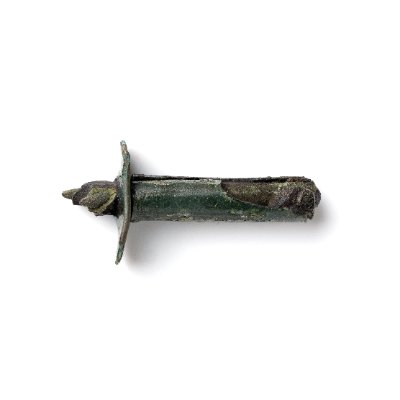
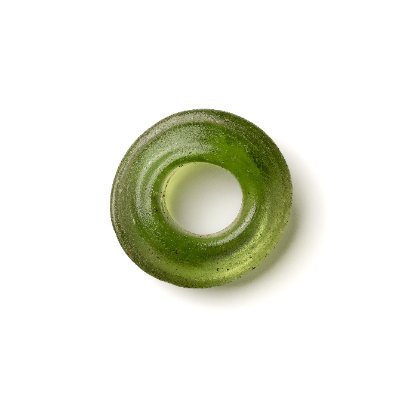
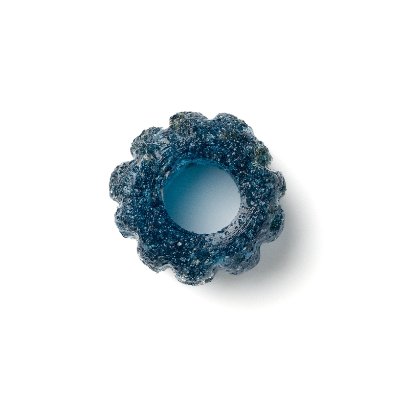
PHOTARCH A visually driven archive tool

MacBook Pro

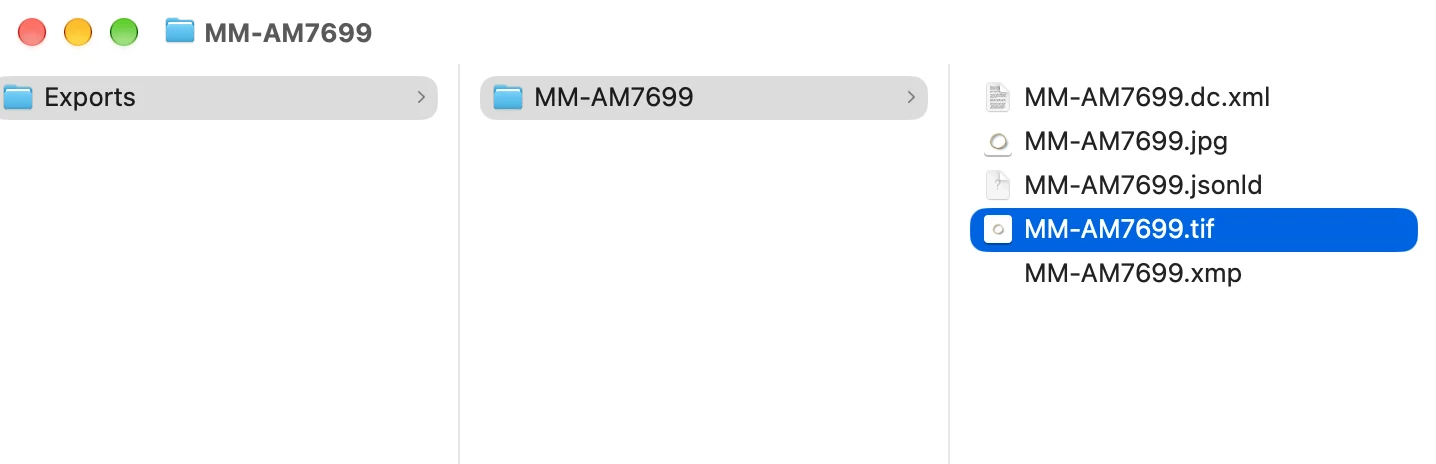
The PHOTARCH app runs on macOS. PHOTARCH for iPhone is a free add-on and works only together with the app on a Mac.

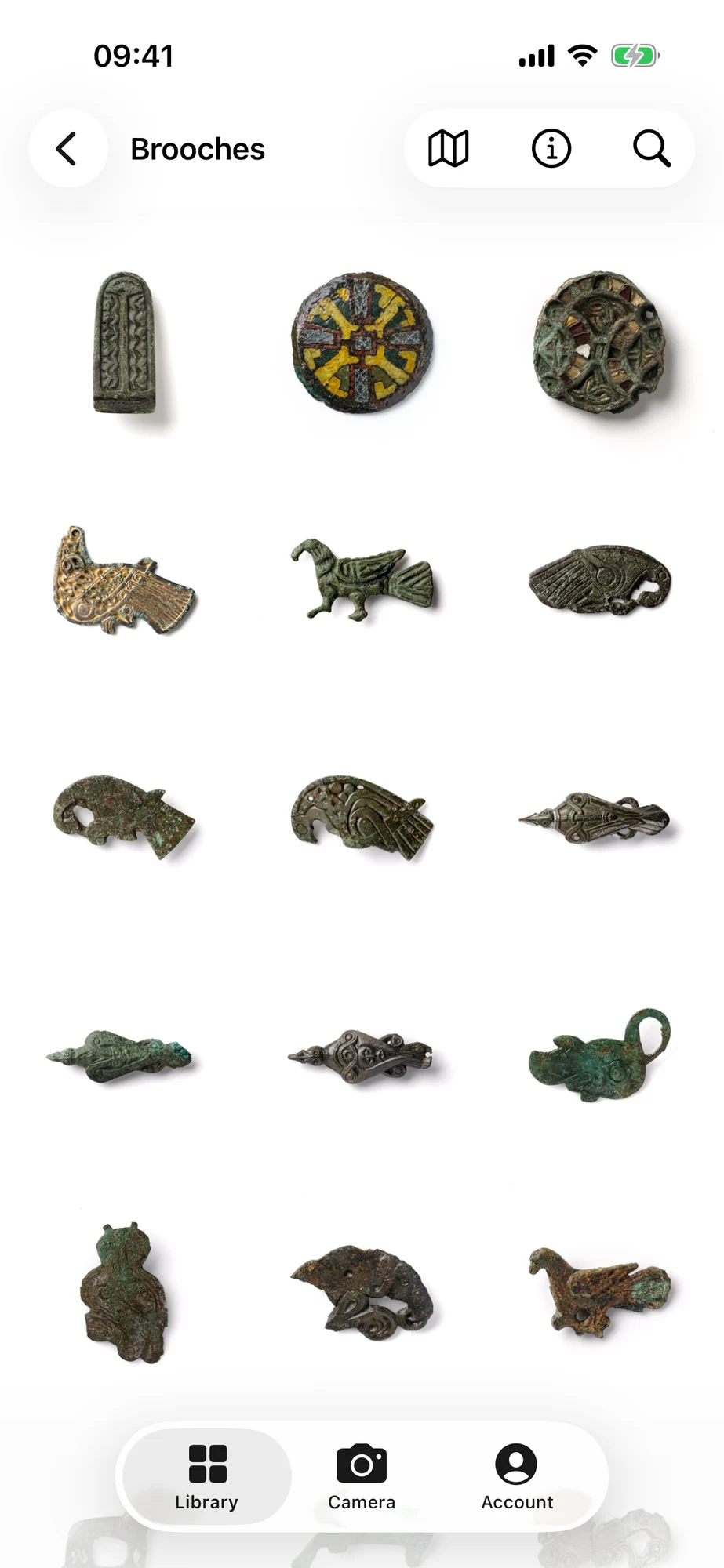
Tired of looking through text when all you want is an image?

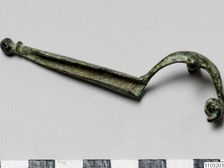
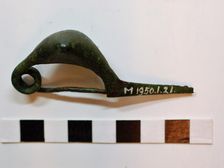
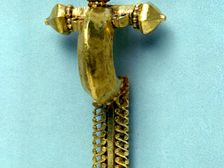
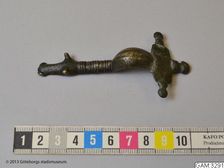
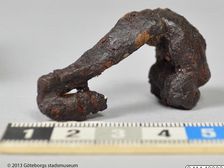
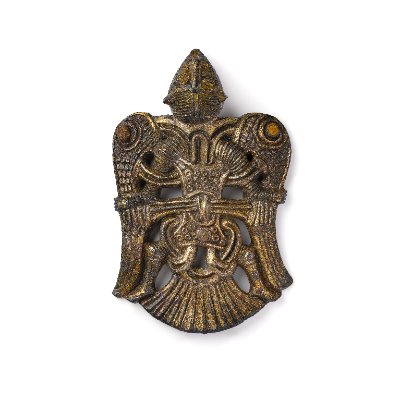
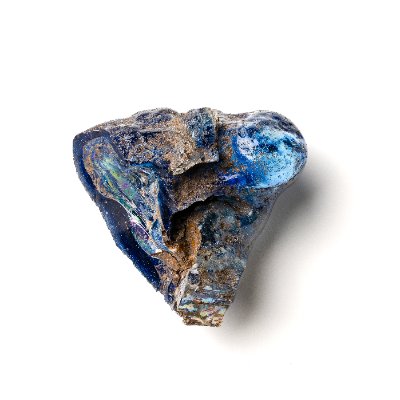
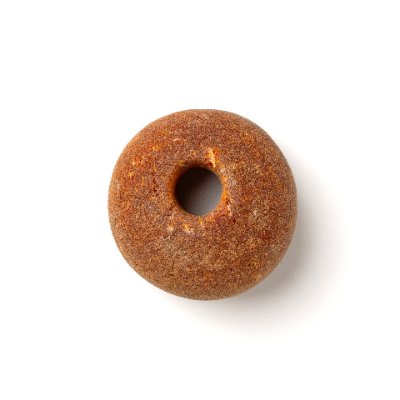
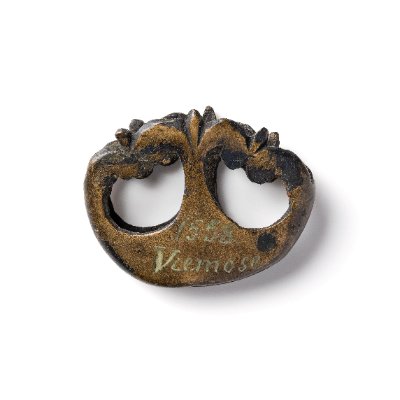
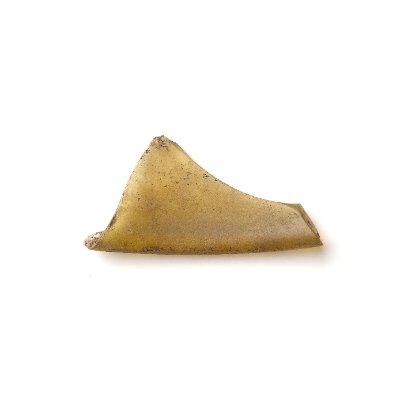
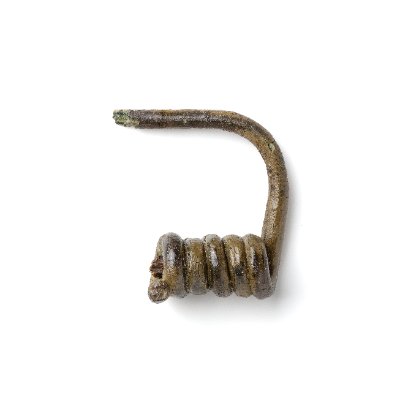
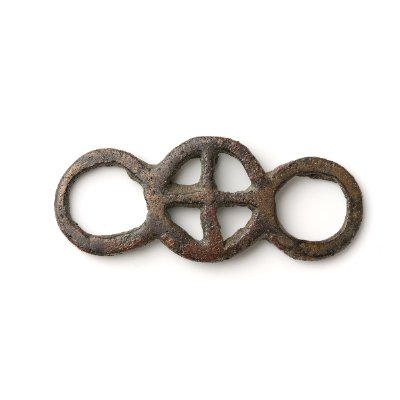
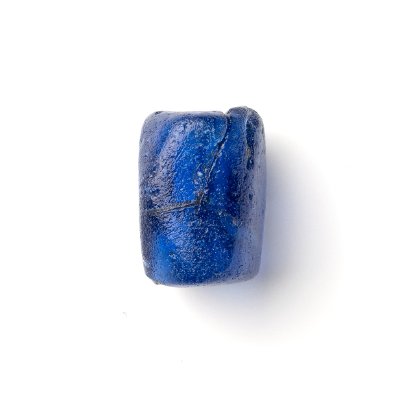
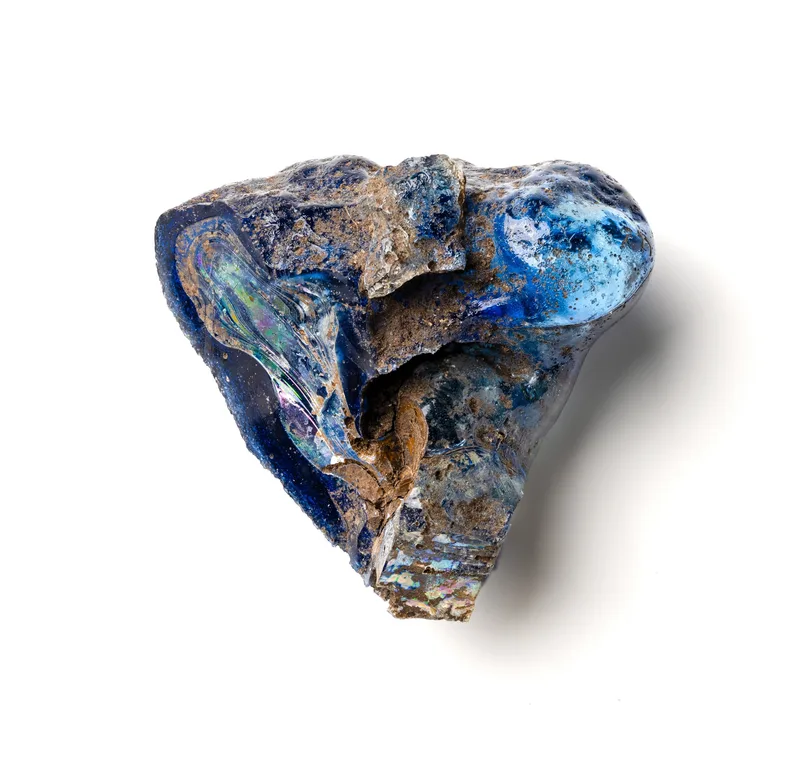
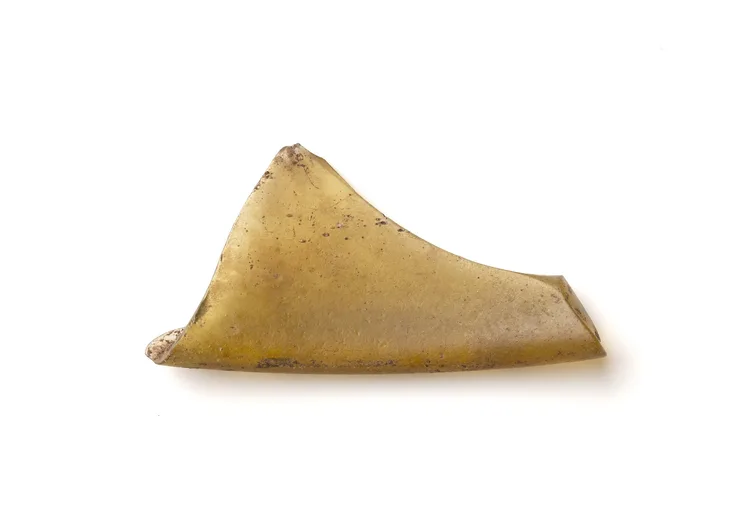
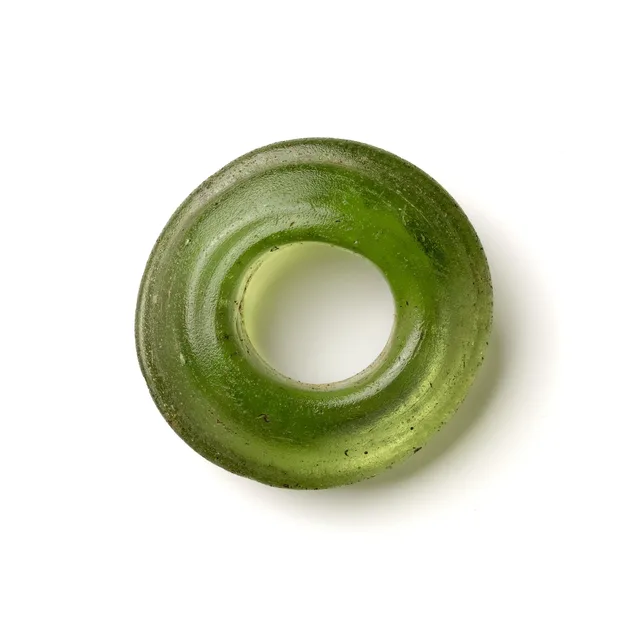
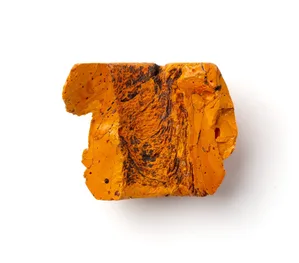
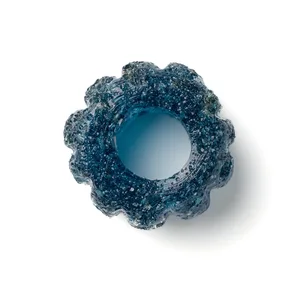
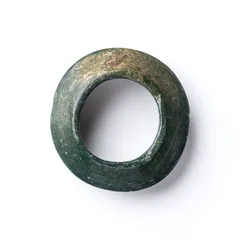
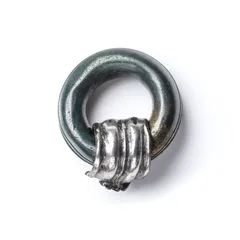
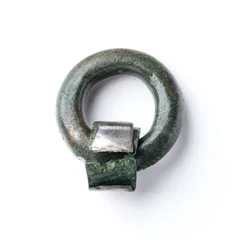
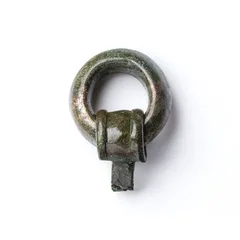
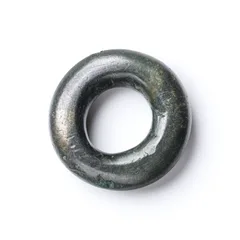
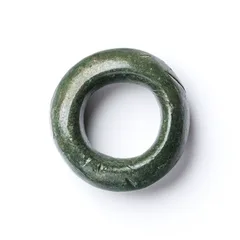
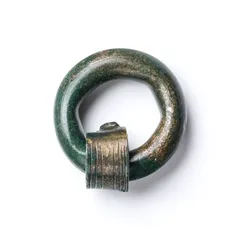
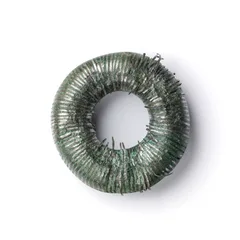
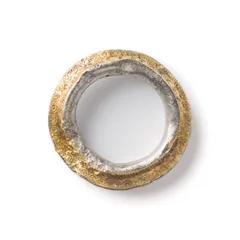
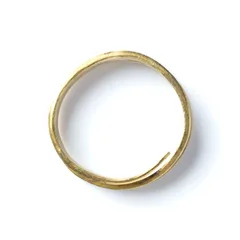
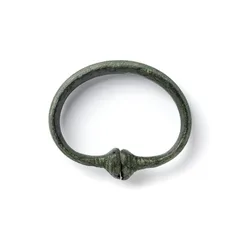
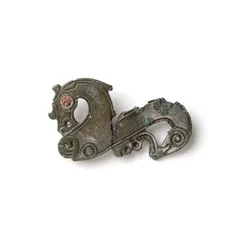
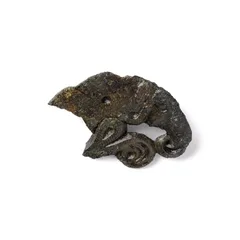
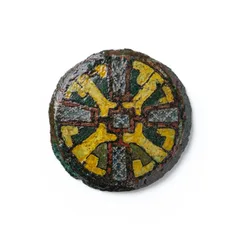
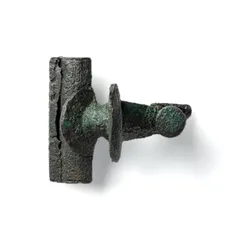
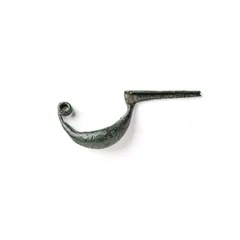
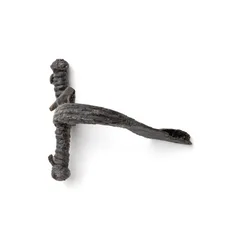
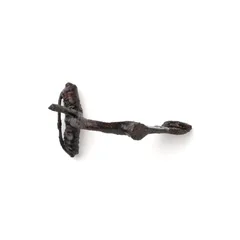
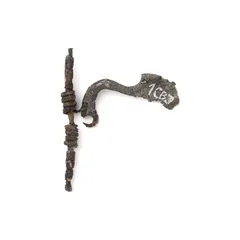
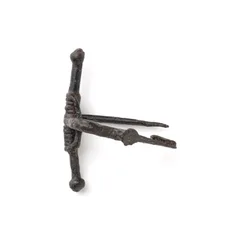
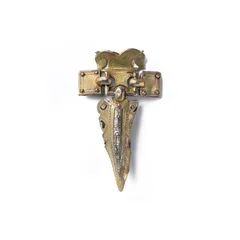
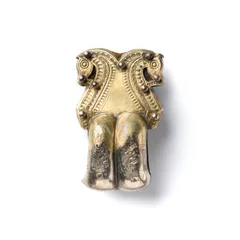
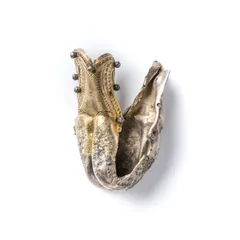
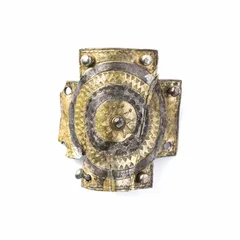
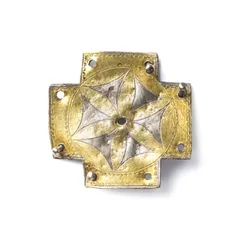
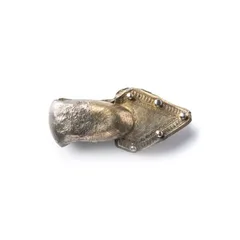
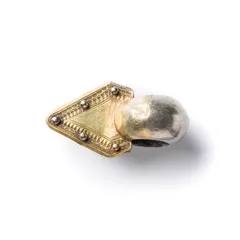
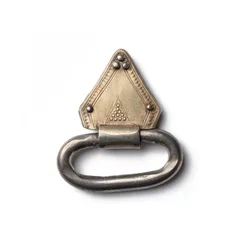
Medelhavsmuseet, SHM 07388:0002, CC0 · Rijksmuseum van Oudheden, Leiden, M 1950/1.21, CC0 · KIK-IRPA, Brussels (Belgium), cliché A125634, CC BY 4.0 · Fondazione Torino Musei, Palazzo Madama, 0012_ORI, CC BY 4.0 · Foto: Stina Damberg, Göteborgs stadsmuseum, GAM:3291, CC BY 4.0 · Foto: Stina Damberg, Göteborgs stadsmuseum, GAM:48303, CC BY 4.0

PHOTARCH is a visually driven database that puts the image first

You search with your eyes, compare objects across collections and edit using your AI.

Objects from Kalmar County Museum, Moesgaard Museum and Lund University Historical Museum · CC BY 4.0

It is a collection management tool that lets you sort your things in scale

Six glass objects from Kalmar County Museum · CC BY 4.0

So many standards you do not have to keep track of

Digitisation comes with a long list of standards, rules and recommendations, and as many abbreviations to tell apart. With PHOTARCH you do not have to: it does all that for you.

Take the picture as well as you can. The app brings it to its best version, without ever altering the original, and says in plain words what it is fit for: a record shot, a study or a reproduction. When you are ready you export it with everything it needs for where it is going next.

FADGI, ISO 19264-1 and Metamorfoze were written for paintings, documents and other flat originals. The app keeps them out of the way, and turns them on, clearly labelled, for whenever they are needed.

Made to suit the smallest collections or the biggest archives

Objects from Kalmar County Museum, Moesgaard Museum and Lund University Historical Museum · CC BY 4.0

PHOTARCH

Nothing but your collection

Step 1: Choose your field

The first time you open the app, you choose where your library lives and what it is about. That one choice sets the app up for your kind of collection.

Every collection can be catalogued, photographed and measured today. A field adds the form, the words and the exports of that field. Until a collection has its own, it uses the archaeology form, and Custom collections, the form you shape yourself, comes next.

The form

Only the fields your collection needs. A collection of stamps never asks for an excavation number.

The words

Vocabularies for your field: the types, materials and dates that make sense for what you keep.

A complete record

What has to be filled in before a record counts as complete, judged by your field and not by another.

The exports

Ready-made export presets, with the formats your field uses first.

Yours to change

A preset is a file. Take away, add and make it your own.

Today

  • Archaeology

In development

  • Custom collections · next
  • Osteology
  • Numismatics
  • Maritime
  • Books and manuscripts
  • Stamps
  • Artworks

The PHOTARCH web archive holds archaeological objects, so publishing there belongs to the archaeology field.

Step 2: Bring in your objects

Import the photographs you already have, or take new ones. Either way, the object’s size is found for you.

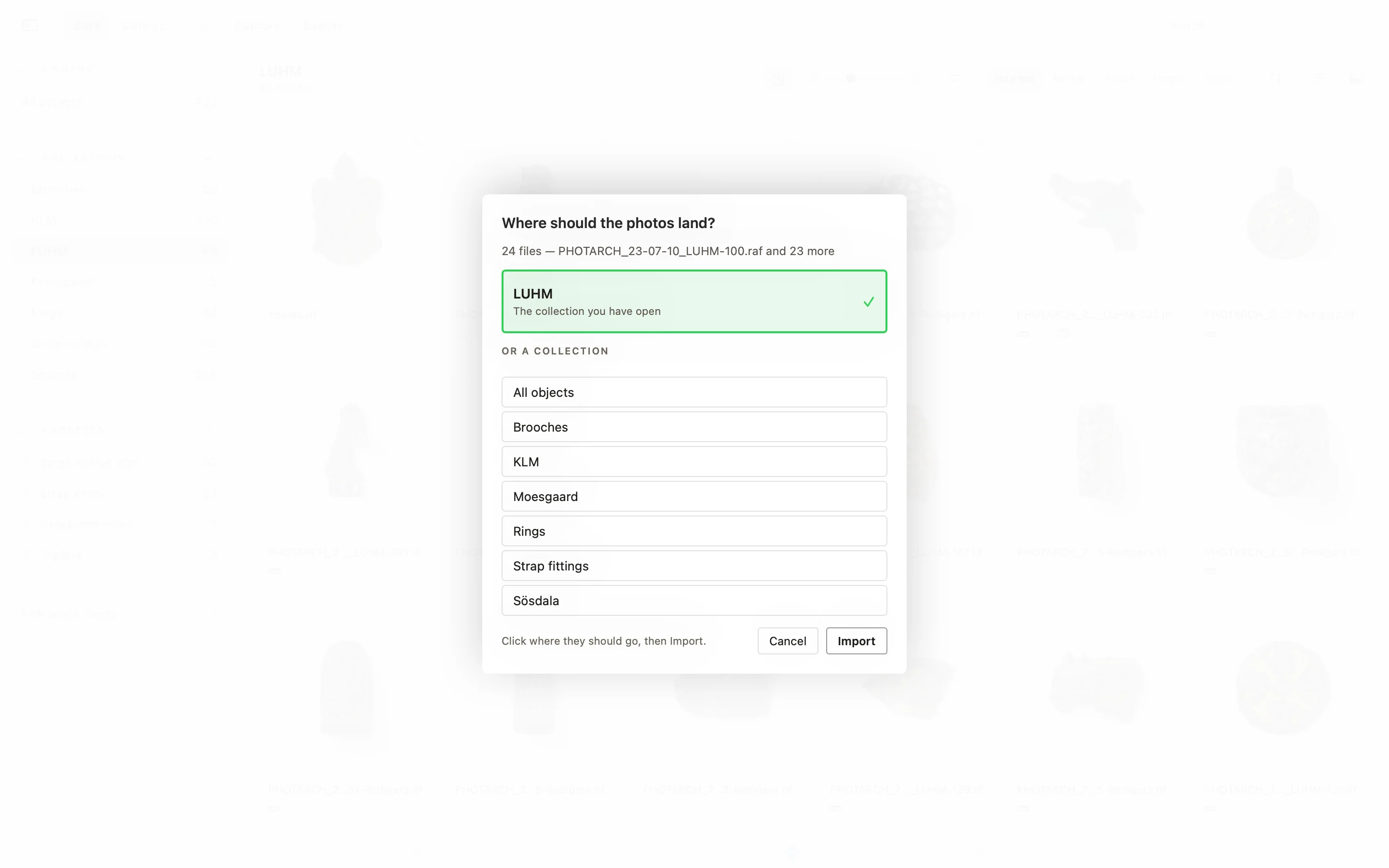
Import

Drag in files and folders, or watch a folder. The originals stay where they are, and nothing is written over.

TetheredPrivate and Organisation

Photograph with a Sony camera on its cable, straight into the library, with the live view and the board check on the Mac. Canon, Fujifilm and Nikon are to come.

PHOTARCH for iPhone

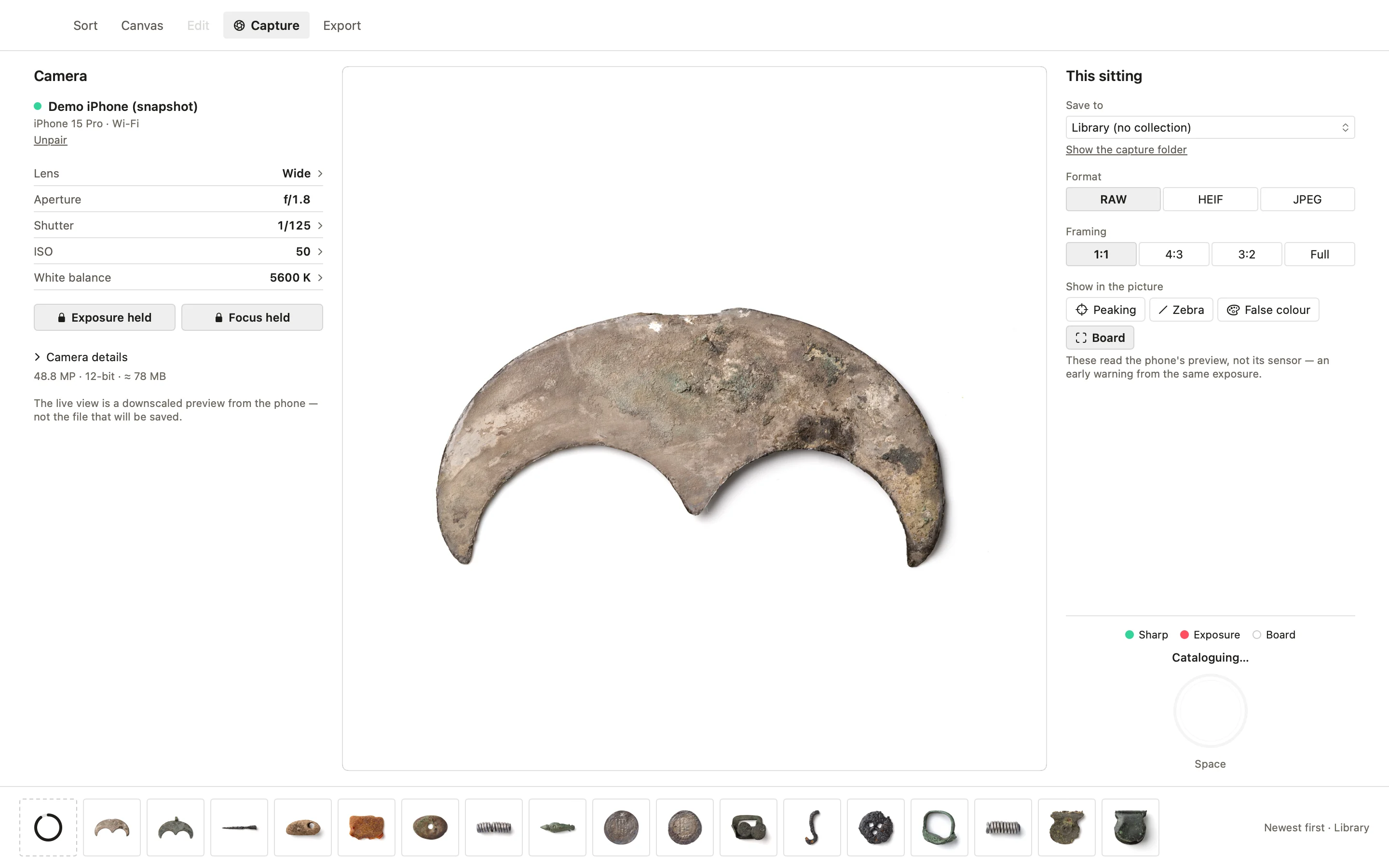
The phone as the camera, over Wi-Fi or a cable, every picture straight into the library. Free on the App Store.

Measured as it comes in

A ruler in the picture

A photograph with a scale bar or a ruler beside the object, imported or taken, has it read and the object’s size set from it.

PHOTARCH markers

On the board, or with loose markers beside the object, the scale is read straight off the markers and the object is found and boxed as it lies.

PHOTARCH Adjust

One press, or ticked on Capture for every picture: the object turned square, the ground taken to white and the picture cropped to 1:1.

Step 3: Assign metadata

Describe each object in your field’s own terms, one at a time or many at once.

Your field’s record

The fields and vocabularies your field uses, and a light that says when a record is complete.

Templates

Save a record as a template and lay it on many objects, or bind it to a collection so that everything imported there is filled in. A template fills what is empty and never writes over what is there.

Records you already have

Import existing records from CSV, JSON-LD and Dublin Core.

Words of your own

Add a term with a suggestion from the Getty AAT. It stays in your library.

Your own AIOrganisation

Let the organisation’s AI tool fill in and put records right. Every change to many objects is shown first and approved in the app.

Step 4: Store and share

Your library stays on your own computer, and what you choose goes out from it: to colleagues, to the web, to an archive.

Originals at home

The library and its originals live on your own computer or drive. There is no cloud storage to pay for, and nothing leaves until you send it.

Export for where it goes

A JPEG for the web, a TIFF for print or a package for an archive, with the record, the true scale and the rights written into the file. Your own presets are kept.

Share with colleaguesOrganisation

Share notes with the whole organisation, and collections and canvases by private link. Several can work on the same objects, each in a library of their own.

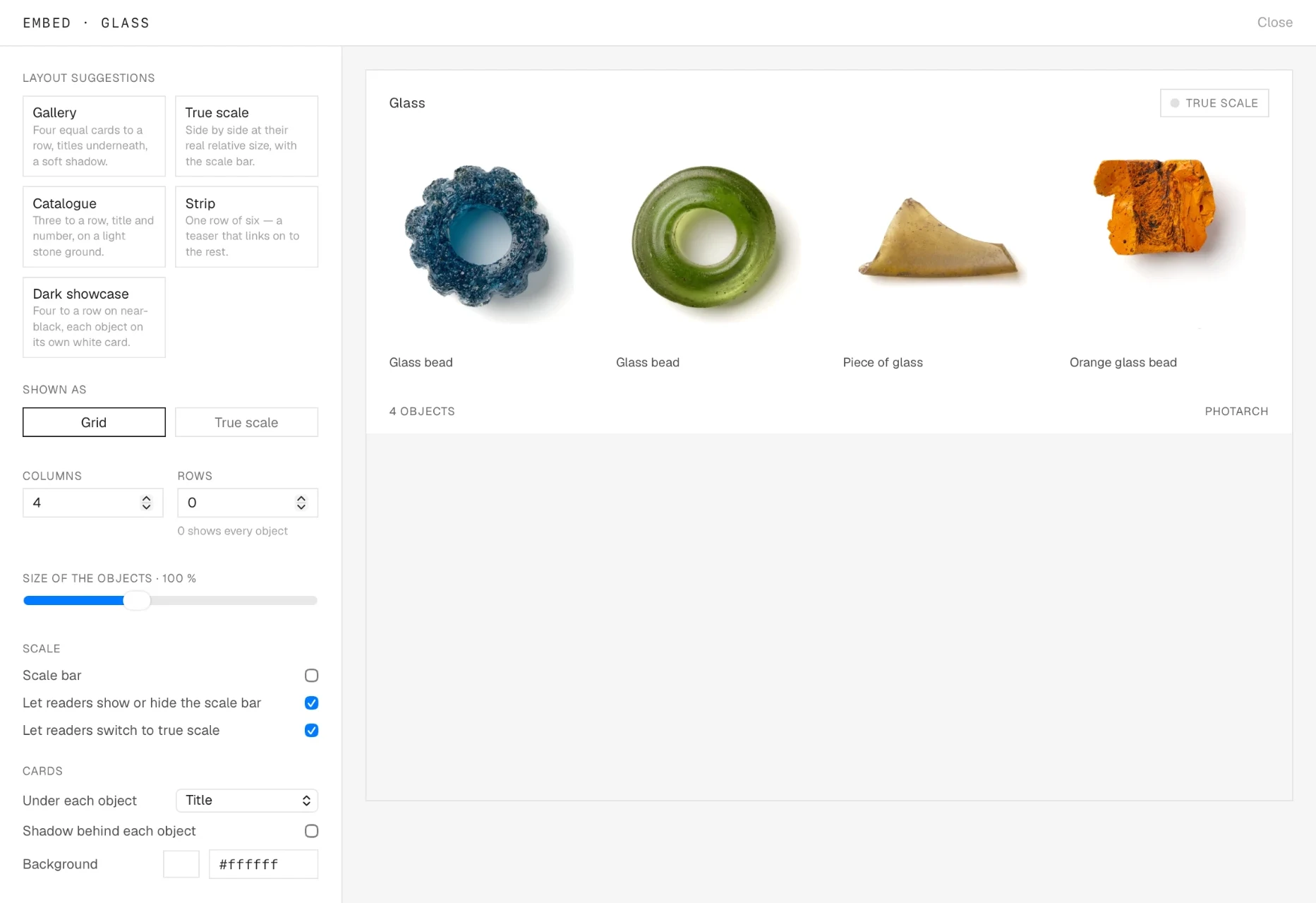
EmbedOrganisation

Put a collection or a canvas on your own website: a gallery, objects side by side at true scale, a catalogue or a canvas as it was arranged, set in a live preview and pasted as one line of code.

How it all works

From here on, every example comes from archaeology, where the method was developed. The app works for any collection.

Not every photograph is alike

Three things a photograph of an object can be

The app says, for every picture, which of them it reaches — and what keeps it from the next. Below, the same twelve millimetres of one object at each level.

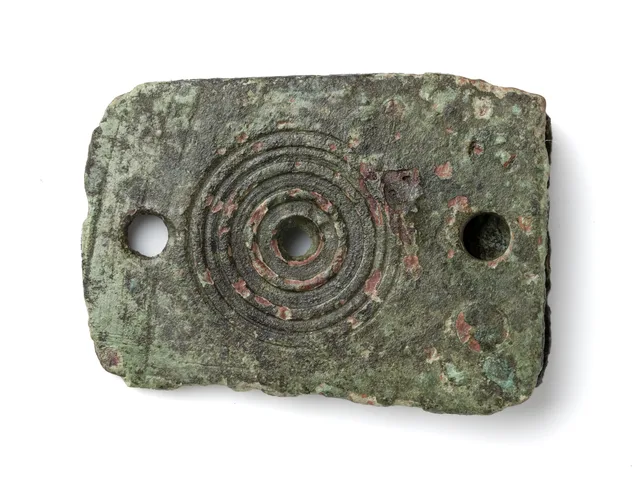
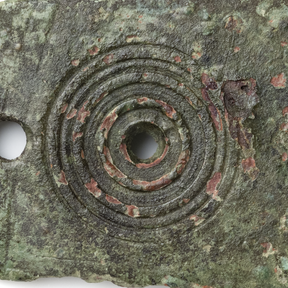
A bronze plate with concentric rings, KLM 35, the twelve millimetres shown below marked
KLM 35 · Kalmar County Museum · CC BY 4.0
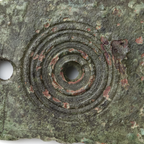
Twelve millimetres of the object at 4 pixels per millimetre

4 px/mm · about 100 ppi

Record shot

To know which object it is

Inventory, loans and condition reports: enough to recognise the object and tell it from the next. Any camera, any file.

Twelve millimetres of the object at 12 pixels per millimetre

12 px/mm · about 300 ppi

Study

To show and publish it

Catalogues, exhibitions and the web, and a print at life size. The scale is set, the colour checked against a ColorChecker, the file raw or lossless.

Twelve millimetres of the object at 24 pixels per millimetre

24 px/mm · about 600 ppi

Reproduction

For research, down to the detail

Kept at about 600 ppi, so you can zoom in on decoration, tool marks and wear as under a loupe, and measure on the picture itself. Scale from calipers or the board, a 16-bit TIFF.

Each level asks more of the picture: the resolution at the object, the scale, the colour, the clipping and the share in focus.

Legacy files

We strongly recommend making every master shot by the PHOTARCH method, whatever your collection holds. Still, millions of images have already been made, many with a scale of some kind in the frame. Import them into PHOTARCH, and they get a measurement automatically.

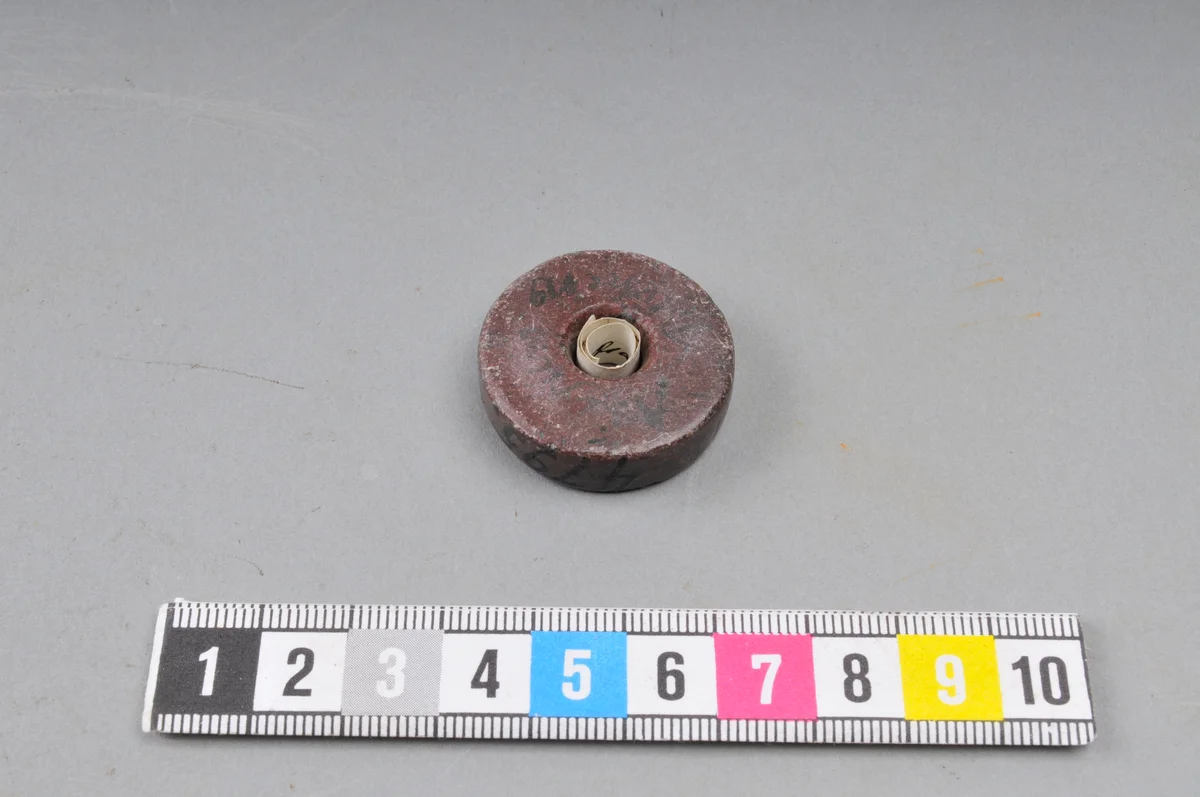
An older museum photograph of a soapstone spindle whorl beside a scale bar, taken at an angle

Wrong: At an angle: the bar cannot measure the object

Photo: Sara Kusmin, Historiska museet/SHM, 1092939, CC BY 4.0

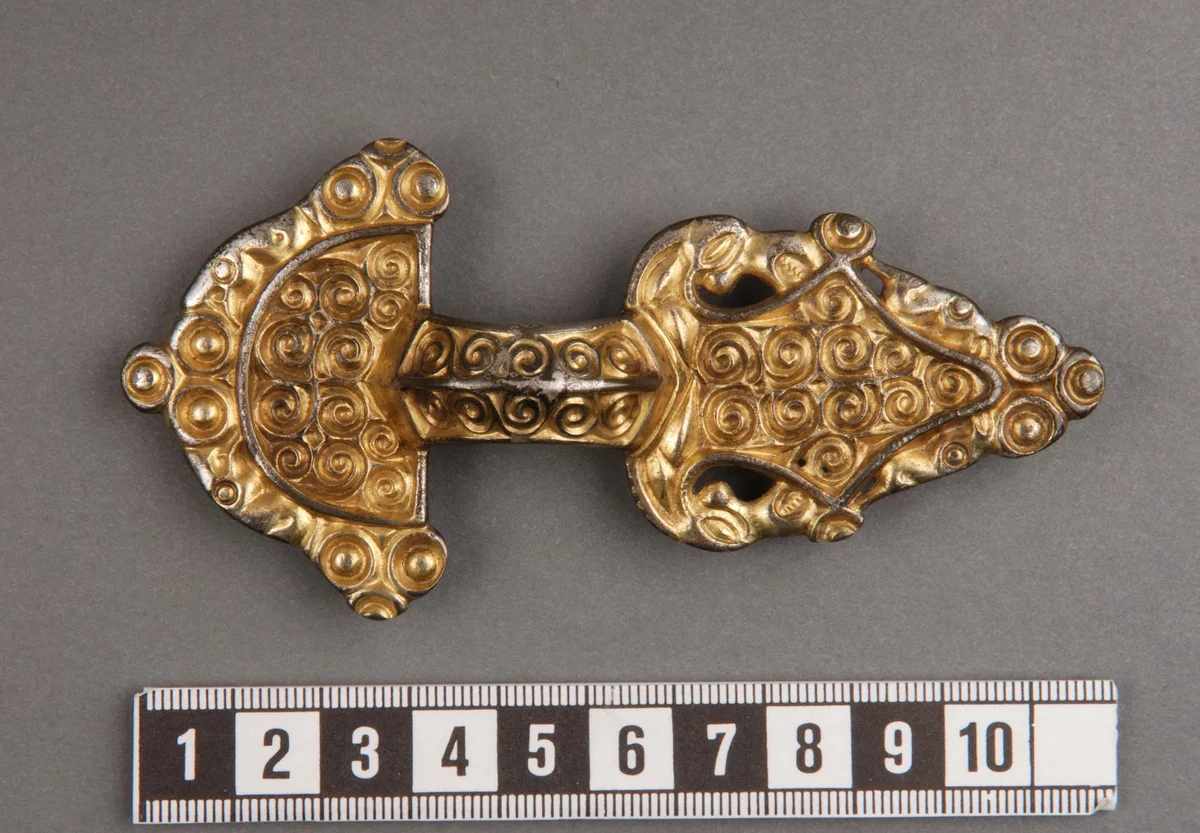
An older museum photograph of a gilt brooch beside a scale bar, taken straight down

Right: In plumb view: the scale is read from the bar

Photo: Christer Åhlin, Historiska museet/SHM, 111888, CC BY 4.0

Older photographs come in as they are. Import one with the scale bar it was taken with, and the app reads the scale from the bar by itself. The bar measure will only be correct when the picture is taken straight down.

01 — The method

Four things, done the same way every time

1

Capture

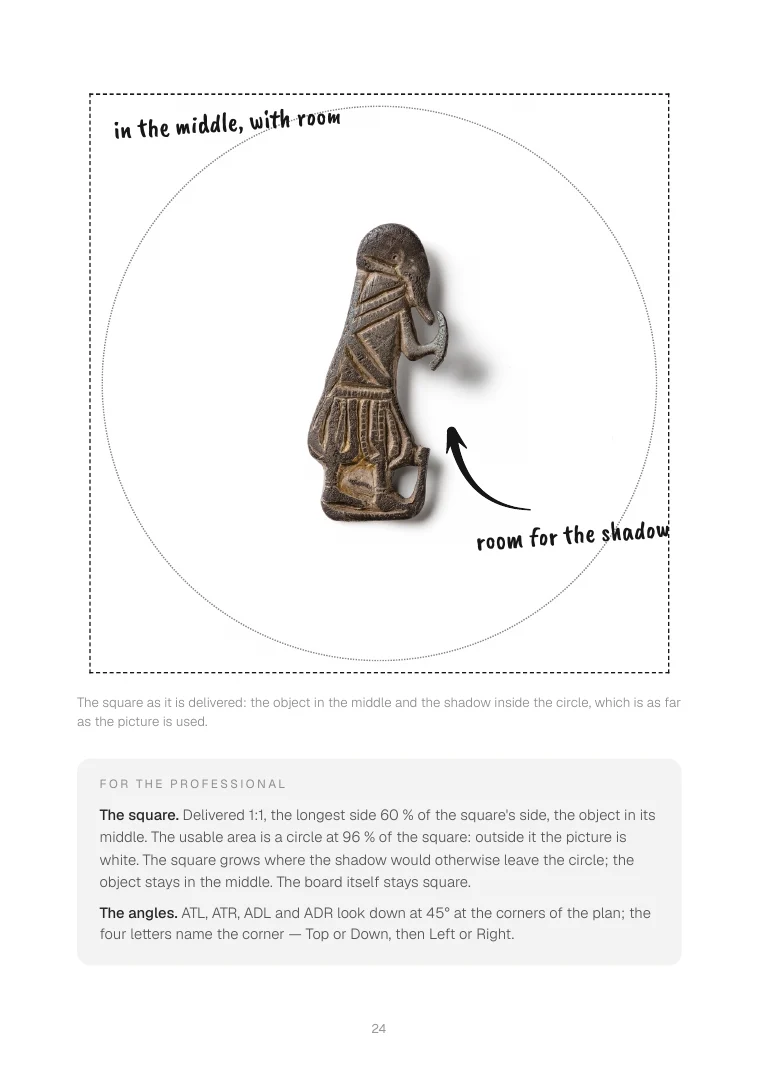
Every object is photographed the same way: one master in plumb view, the camera straight above the object, on white, with the light from the same direction every time. That is what lets any object be laid beside any other.

12 3 6 9 10:30 4:30 KEY LIGHT10:30 · 45° ABOVE 1 CAMERAON A COPY STAND,PLUMB ABOVE 2 FILL LIGHTAT 4:30, OPPOSITETHE KEY 3 CAST SHADOWTOWARD 4:30 4 PHOTARCH BOARDA MARKER INEACH CORNER 5
  1. KEY LIGHT — 10:30 · 45° above
  2. CAMERA — on a copy stand, plumb above
  3. FILL LIGHT — at 4:30, opposite the key
  4. CAST SHADOW — toward 4:30
  5. PHOTARCH BOARD — a marker in each corner
Seen from the front left. The same geometry in every sitting, and in every studio that follows the method, is what lets two photographs be laid side by side.
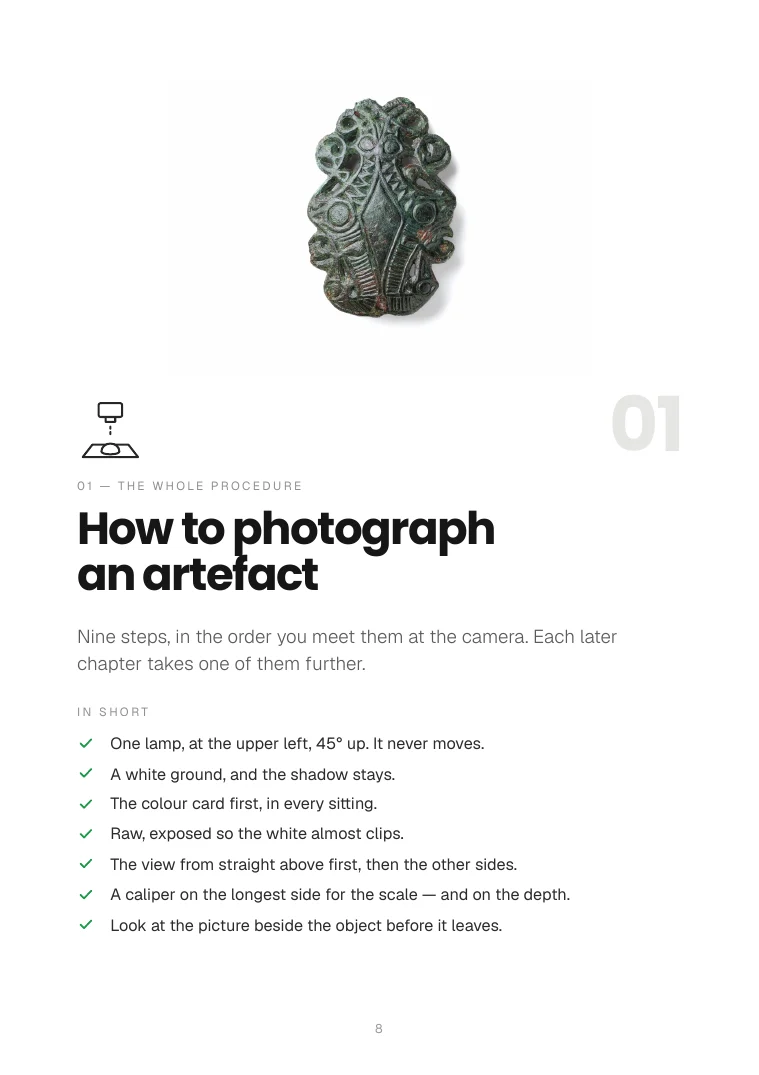
The set-up, as in the guide How to photograph artefacts: the camera straight above, the key light at half past ten, the shadow toward half past four.

2

Validate

The app checks exposure, sharpness and colour — while the picture is taken and after. At capture, three lights say whether the middle of the frame is sharp, whether highlights are clipping and whether the board reads flat and square. Afterwards it measures the scale, the resolution at the object, how much of the object is in focus and how much of it is clipped, the colour against a ColorChecker, the bits the camera recorded and the format, and says what each picture is fit for: a record shot, a study or a reproduction, and what keeps it from the next. For paintings, documents and other flat originals, FADGI, ISO 19264-1 and Metamorfoze can be turned on.

  • Resolution at the objectgreen
  • Scalegreen
  • Colourorange
  • Exposuregreen
  • Capture and filegreen
  • Sharpnessgreen
  • Fit for study
Six things are measured, each with its own light: green, orange or red. Together they decide what the picture is fit for, and the lowest light sets the level. All green is a reproduction, orange at worst a study, and any red a record shot.

3

Measure

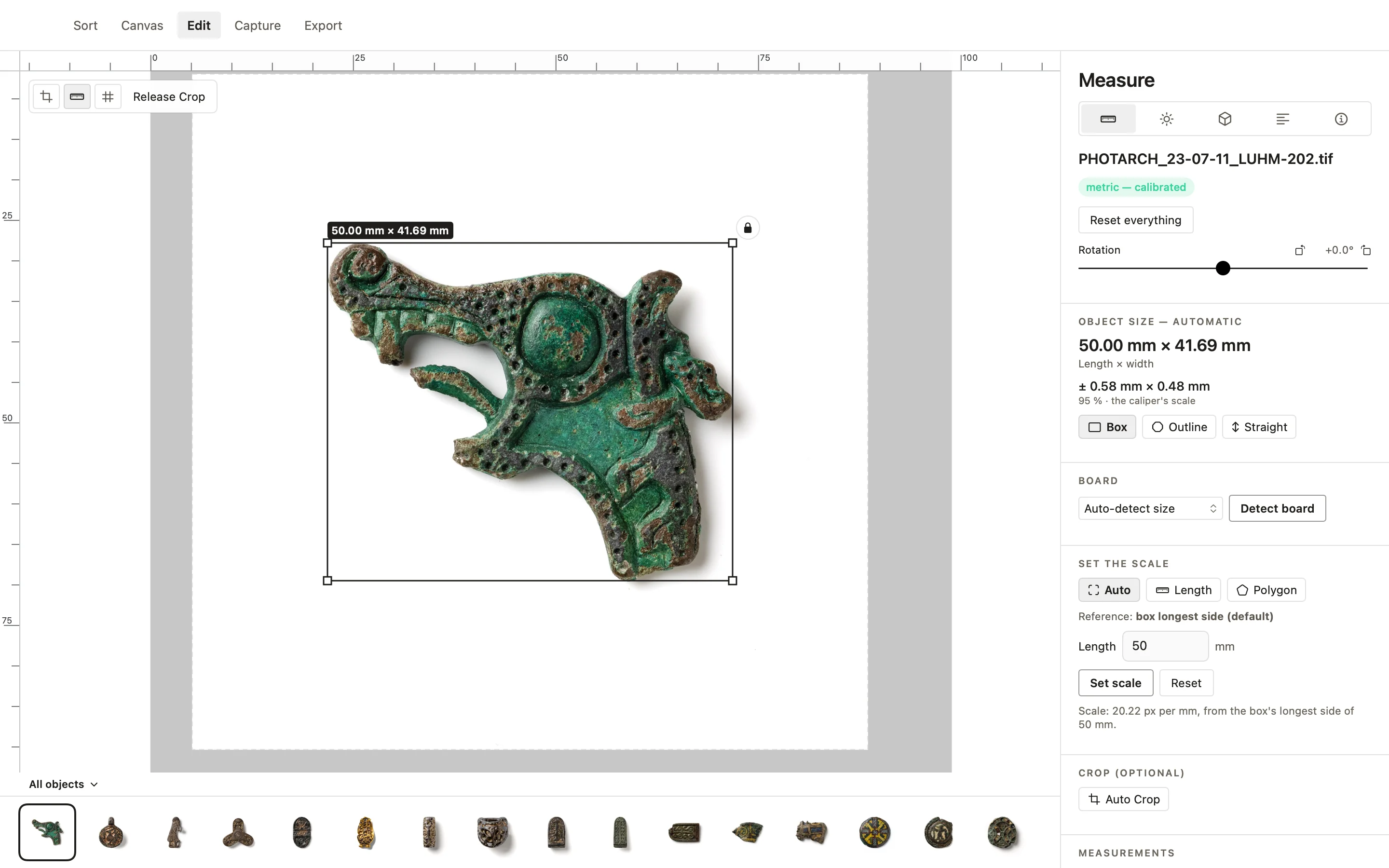
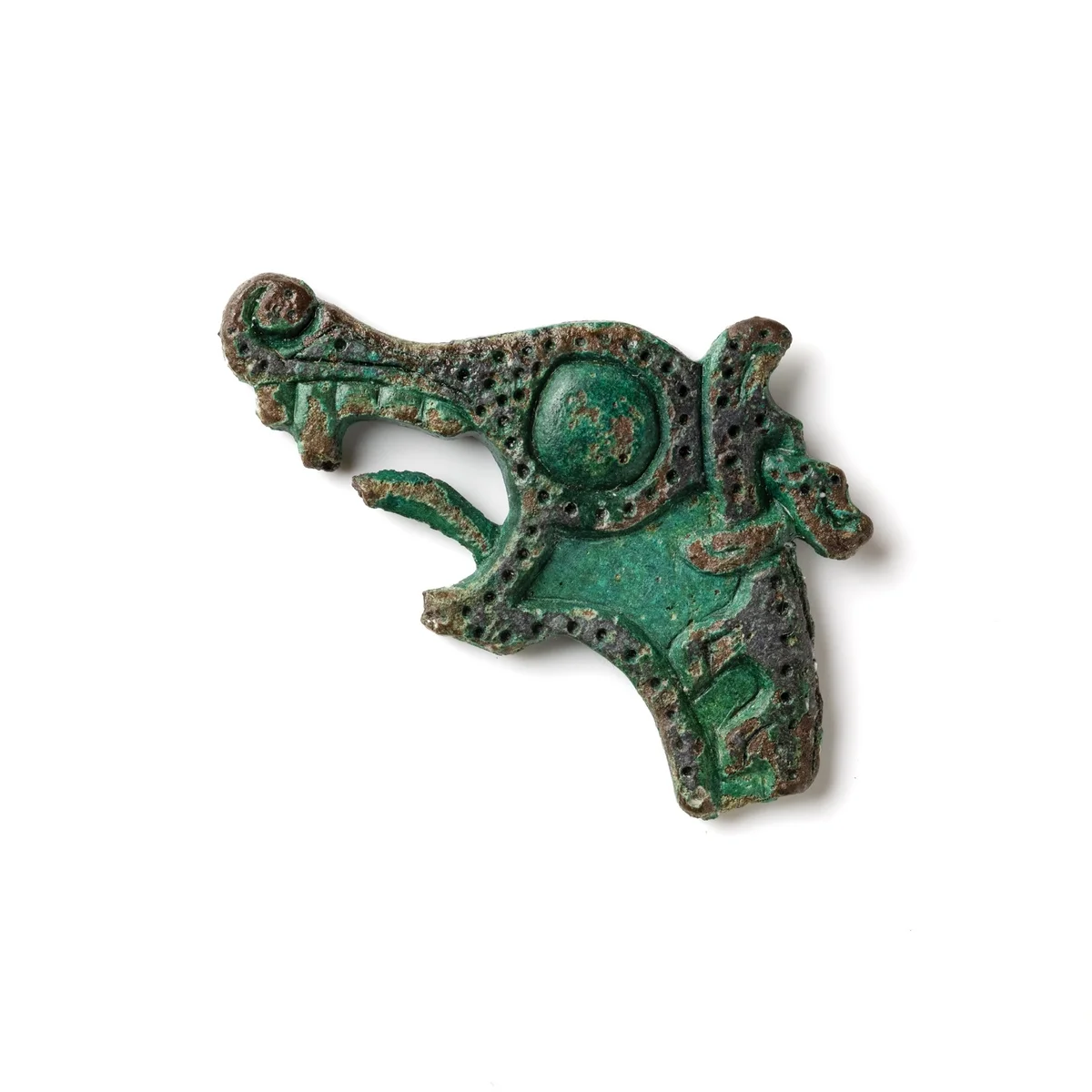
Scale comes from the object’s longest side, measured with a digital caliper — or, calibrated, from the PHOTARCH board, whose markers lie in the object’s own plane — not from a guess. Every object carries millimetres per pixel, a bounding box and its real dimensions, so two objects can be laid side by side at true size.

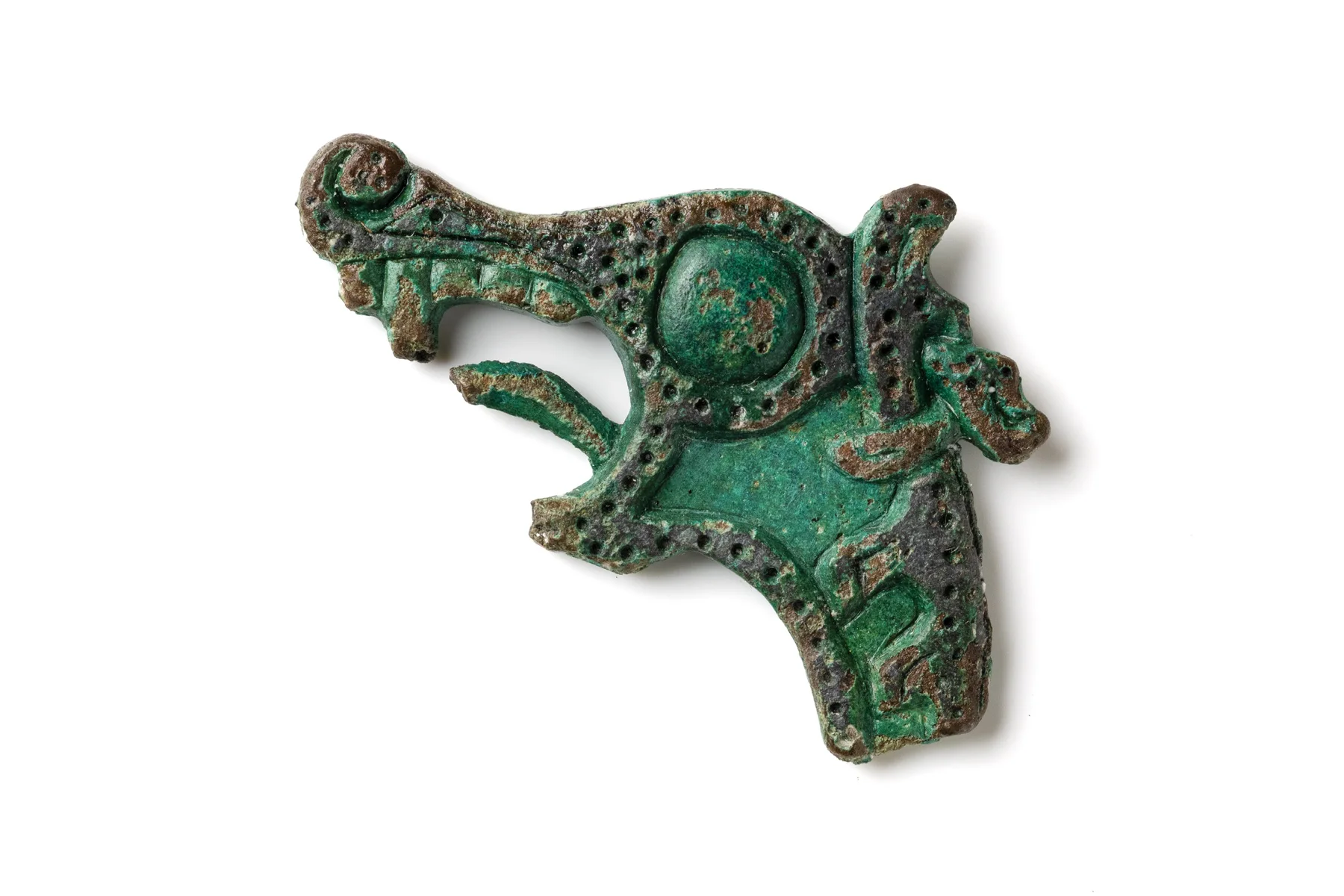
A dragon figure on white, inside a measurement box marked 35.00 mm by 29.18 mm
35.00 mm × 29.18 mm
Dragon figure, Lund University Historical Museum · CC BY 4.0

4

Package

The master is never altered. An export gathers what the museum’s own collection system takes in — the TIFF, a JPEG, the attachments and the record as CSV or a standard format — with the metadata written into the files, so the evidence survives the software that made it.

An exported package: the master TIFF, a JPEG, and the record as XMP, Dublin Core and JSON-LD

02 — The collection

Collection management, whatever the size

A private collection, a society or a small museum can keep everything here: the record, where each object is kept and what happens to it. A large museum keeps the system it has, and PHOTARCH hands it better material, ready to import. Either way, every object can be compared with any other, in scale.

What it manages

The record, where each object is kept, and everything that happens to it, on the organisation’s own computers. The organisation can choose to share its store map — the places and what stands where — so every computer sees the same one; never the pictures, the records or a find spot.

A record for every object

Controlled vocabularies, the organisation’s own fields, fragments and angles, notes and attachments — and rights and embargo per object.

Where it is

Shelf, location and accession number, kept inside the organisation — never published.

What happens to it

Intake, acquisition, location and movements, inventory checks, condition, conservation, loans out and in, exhibitions, valuation and insurance, damage and loss, use and reproduction, deaccession — each a dated entry, as often as it happens.

For one object or many

An entry is written for a whole selection at once — a move of a box, a condition check of a drawer.

The organisation’s rules

The organisation’s admin sets how everyone works with the material: which procedures are used, and how the store is laid out — row, shelf, box, object. The app follows them for every photographer.

If you already have a system

CSVTIFFJPEG THE PHOTOGRAPHON THE BOARD,FROM ABOVE 1 PHOTARCHVALIDATED,MEASURED, PACKAGED 2 AN EXPORTIN THE FORMATSYOUR SYSTEM READS 3 YOUR SYSTEMTHE COLLECTIONSYSTEM YOU USE 4
  1. THE PHOTOGRAPH — on the board, from above
  2. PHOTARCH — validated, measured, packaged
  3. AN EXPORT — in the formats your system reads
  4. YOUR SYSTEM — the collection system you use

Formats your system already reads

TIFF masters and JPEGs with the record embedded in the file as XMP, and the records themselves as CSV, Dublin Core, LIDO or JSON-LD — the formats collection systems import.

Fields that line up

Records follow controlled vocabularies and the organisation’s own fields, so what comes out matches the columns the system expects instead of needing to be retyped.

Start where you are

No migration needed. Begin with one collection beside the system you have, or let the app be the system if you have none.

Every object is a record

What the library and the archive hold is the object: one record, with a master picture at its head and everything else gathered under it.

  1. 1

    The record

    The number, the name, what it is made of, where it was found and when. What the object is, written once.

  2. 2

    The master

    One picture stands for the object: straight down, on white, with its scale in the file. It is what Sort shows, what the archive publishes, and what the three levels judge.

  3. 3

    Everything else

    Other views — the back, the sides, angles from above, close-ups — each a photograph measured on its own. And the files that travel with the object: older photographs, drawings, scans, reports, notes and 3D models.

Fragments, angles and attachments each have something to try in the features below.

Record · 31000:2684Dragon figure
A bronze dragon figure on white, photographed straight down: the master picture of its recordMaster · plumb view35.0 × 29.2 mm

Views

  • Back
  • Side
  • Angle
  • Close-up

Attachments

  • Older photograph
  • Drawing
  • Report
  • 3D model
Dragon figure, Uppåkra, Viking Age. Lund University Historical Museum, LUHM 31000:2684. Photograph: Daniel Lindskog PHOTARCH / Historiska museet, CC BY 4.0. Views and attachments are shown as places.

03 — The app at work

A collection you can see, not just search

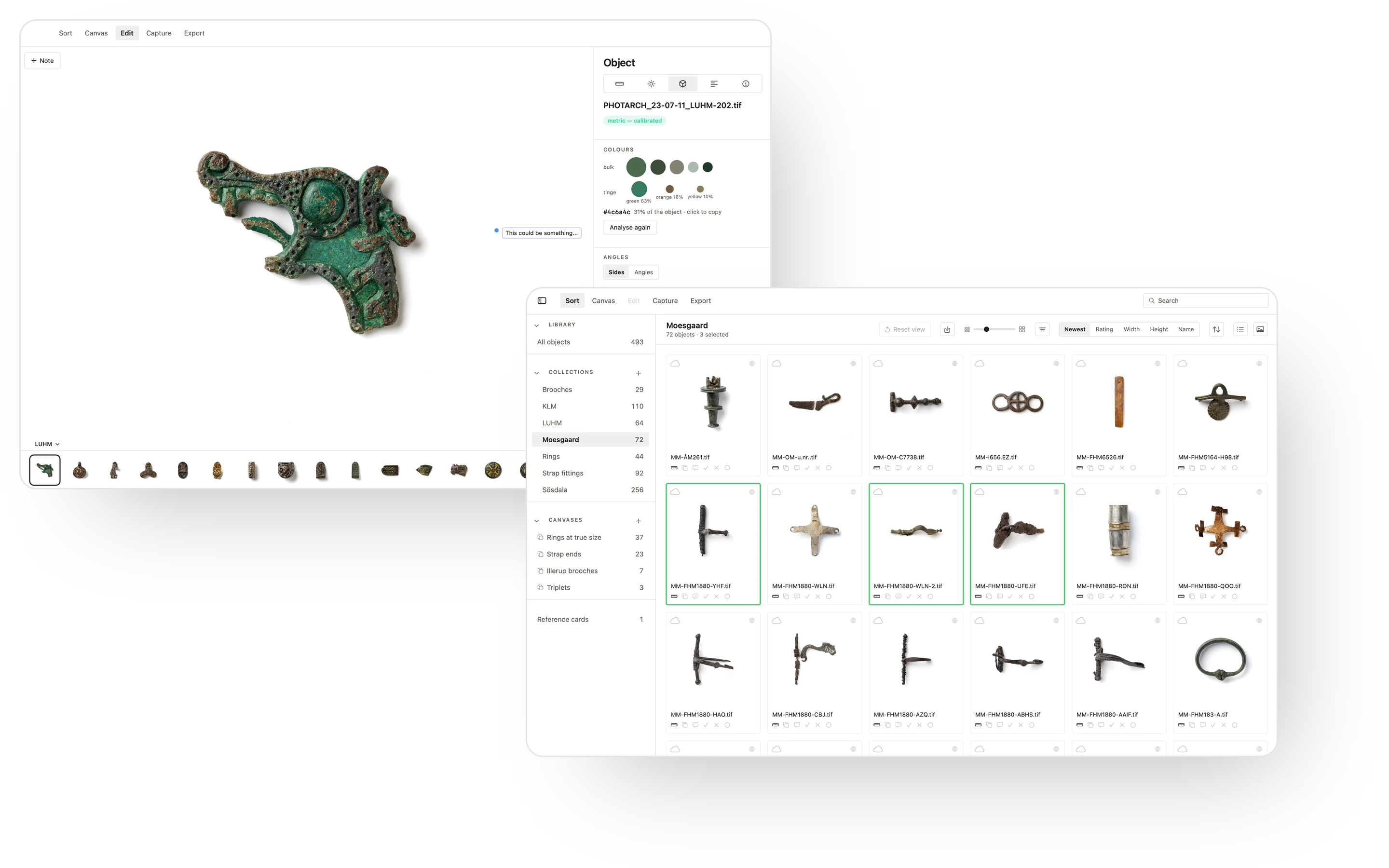
One app, from the shutter to the archive — the library on the Mac and the camera on iPhone.

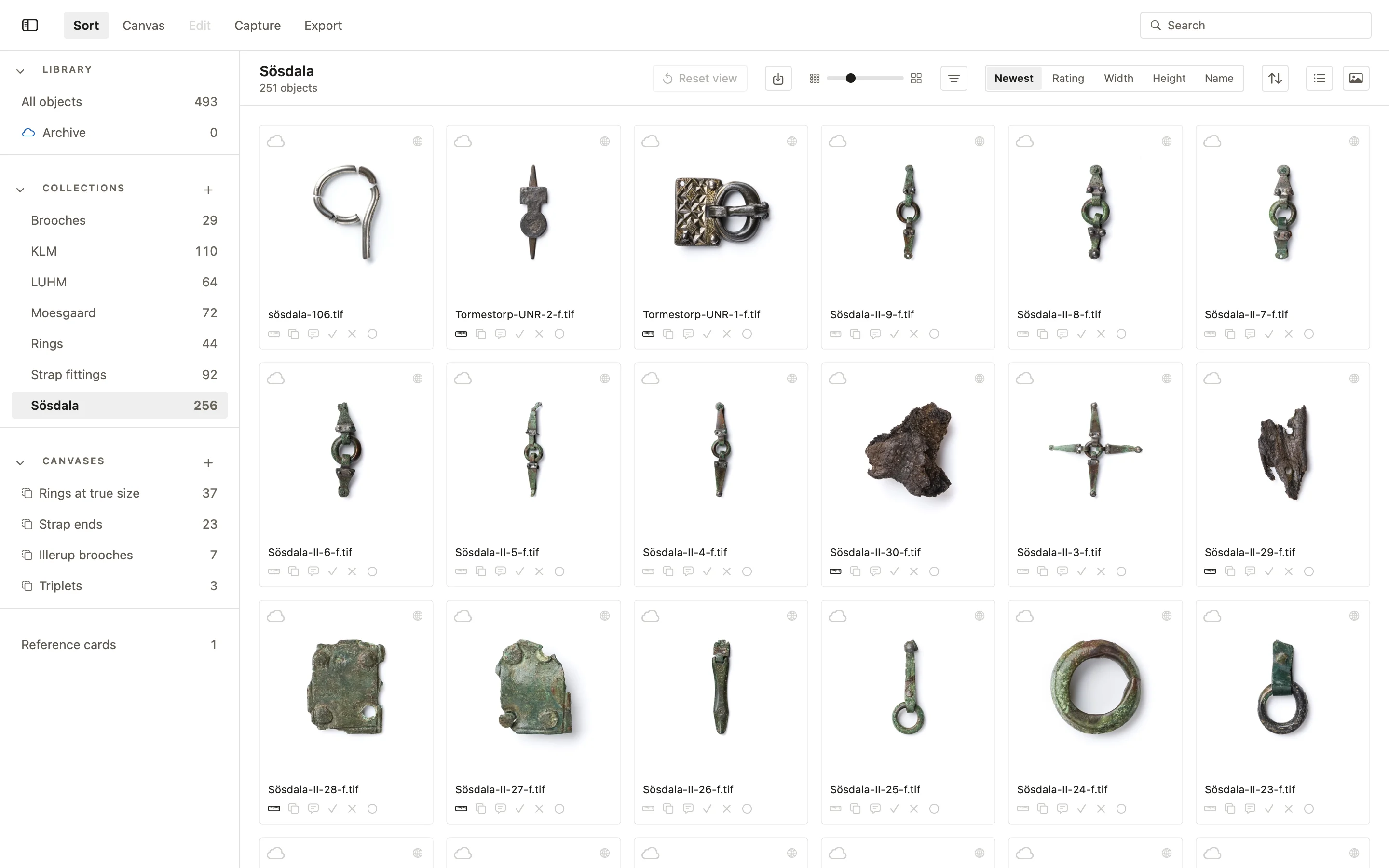
Sort in the PHOTARCH app

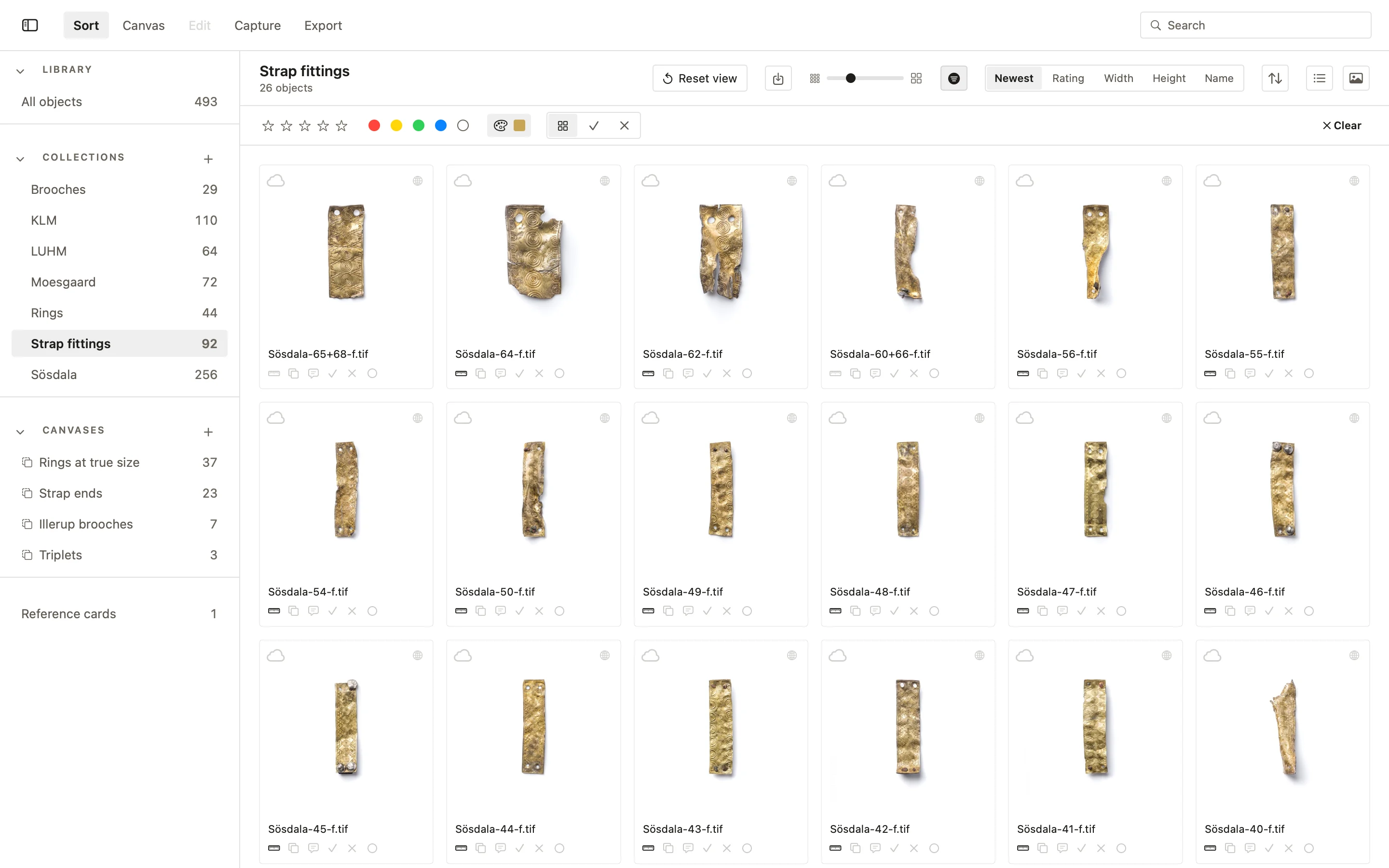
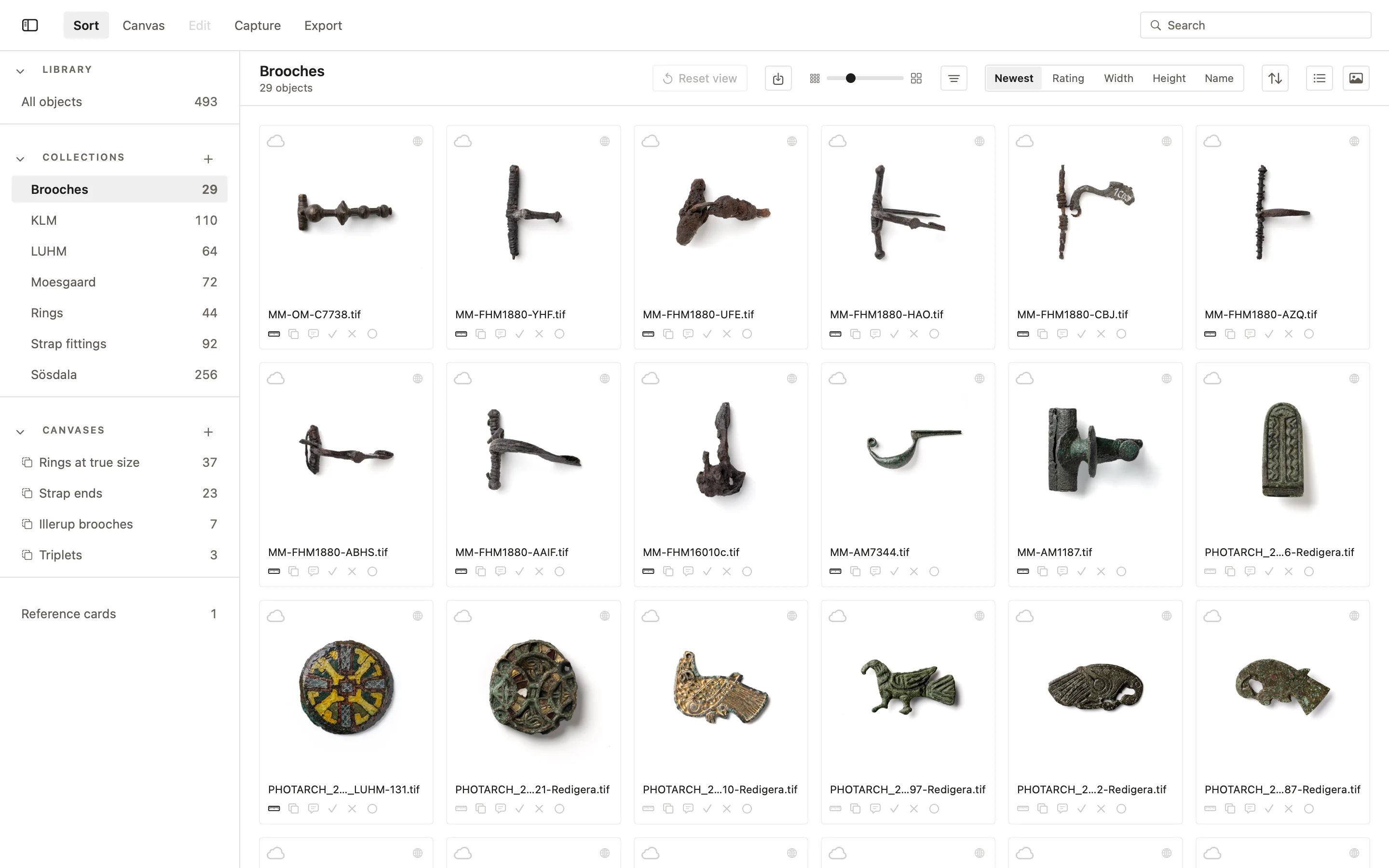
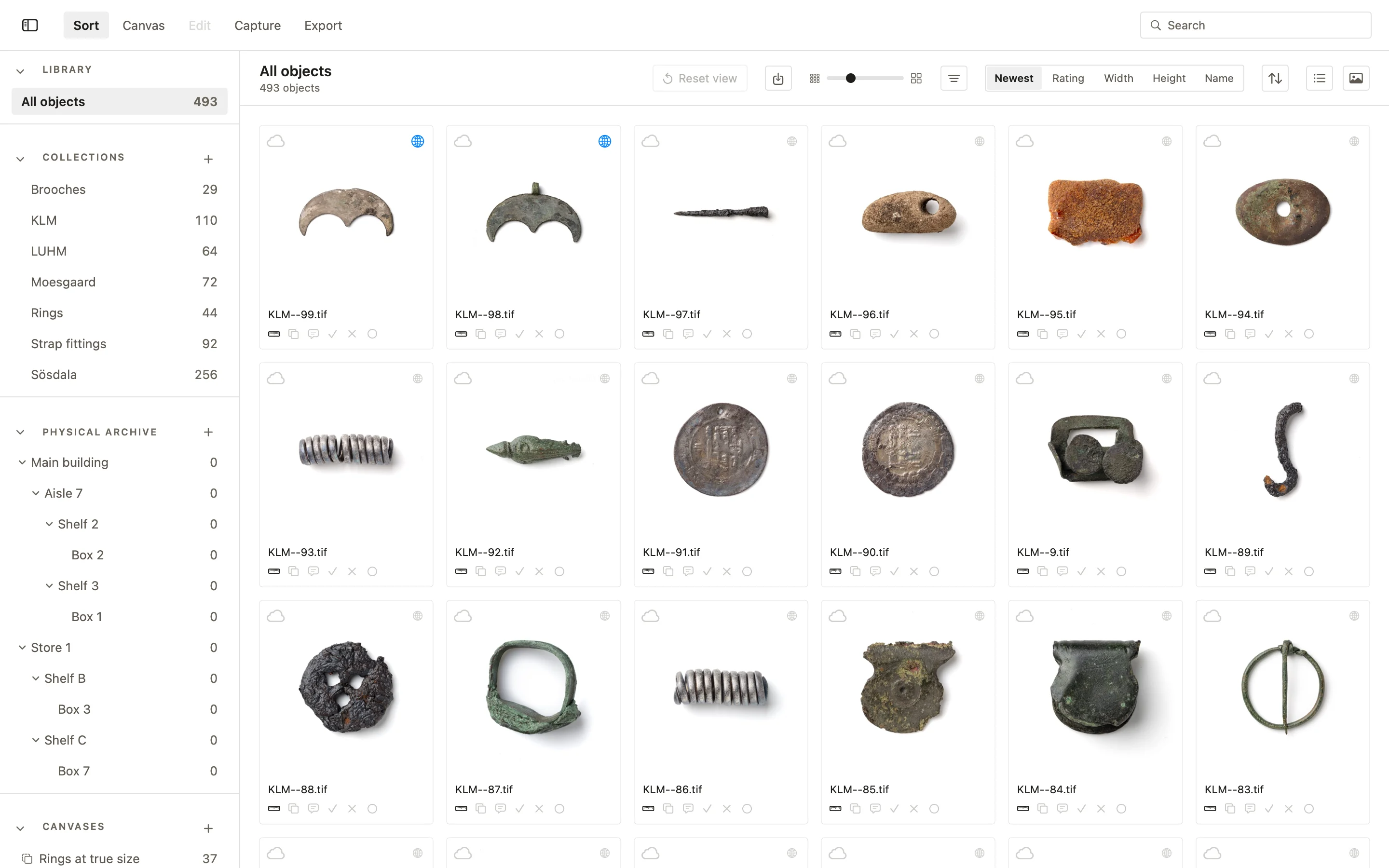
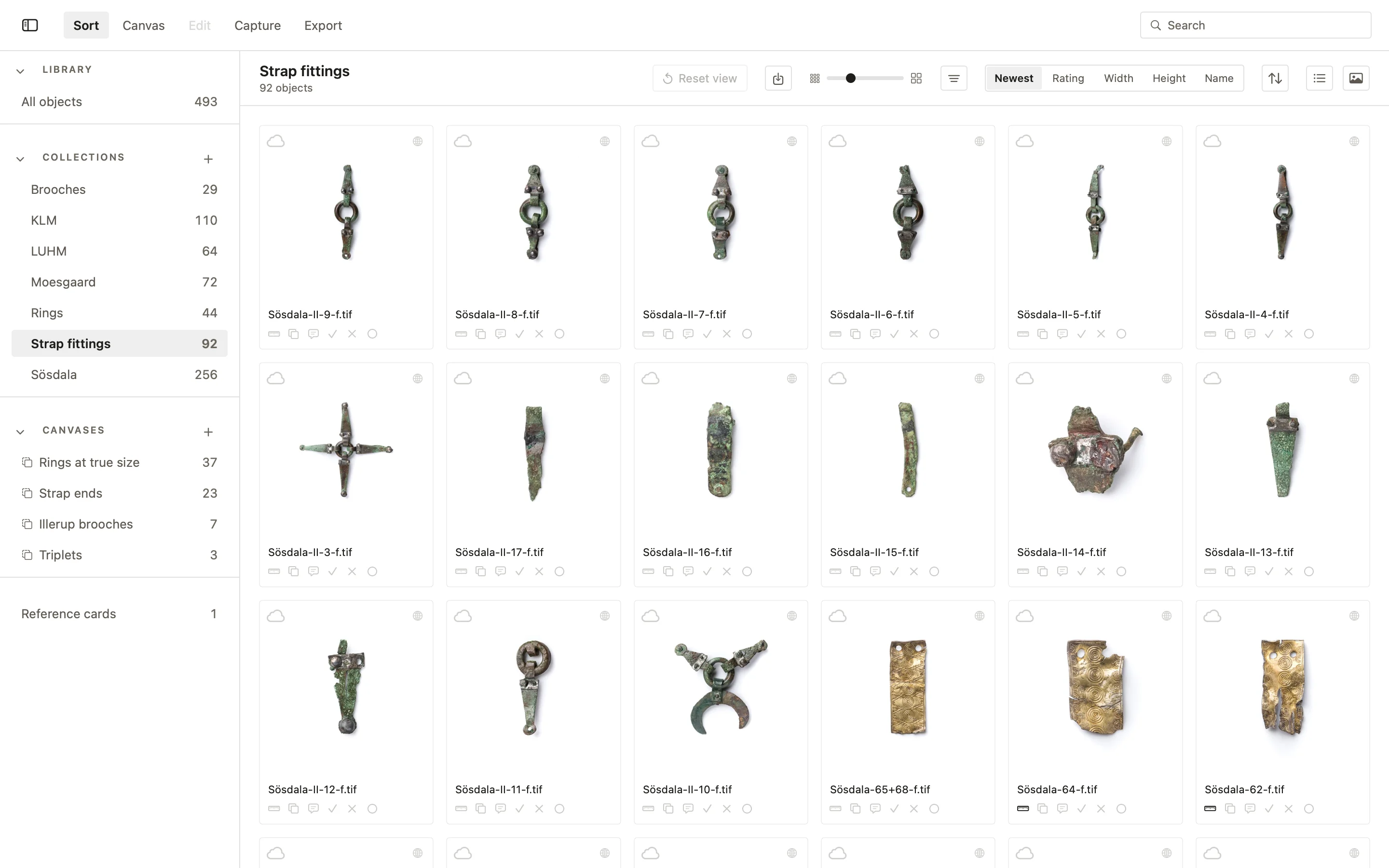
Sort

A grid of every object on white, with ratings, flags, colour labels and keys for culling, search and filters. Search by colour too: pick a colour on the wheel and see every object that has it — the colours the object is mostly made of, measured, not guessed.

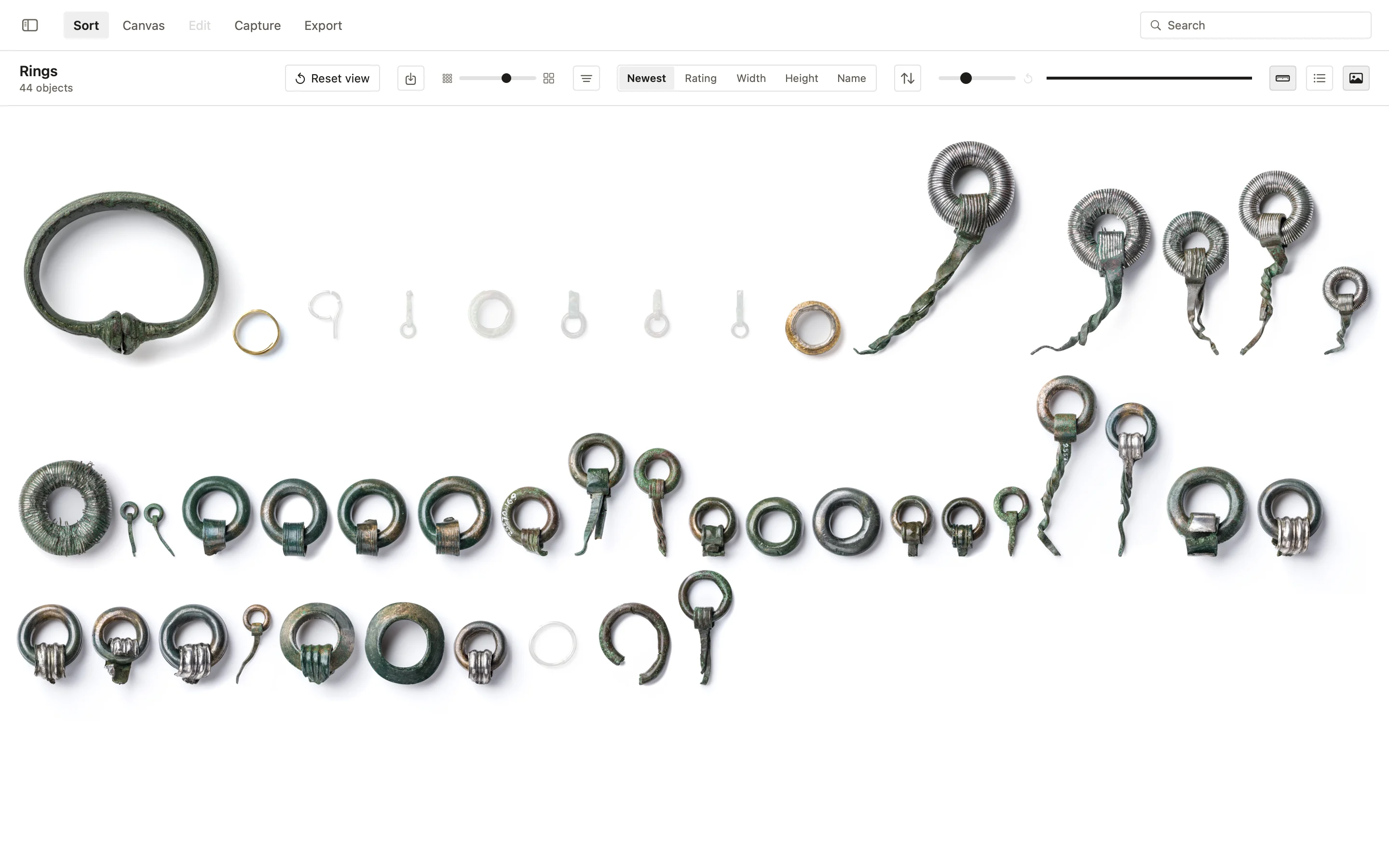
Canvas

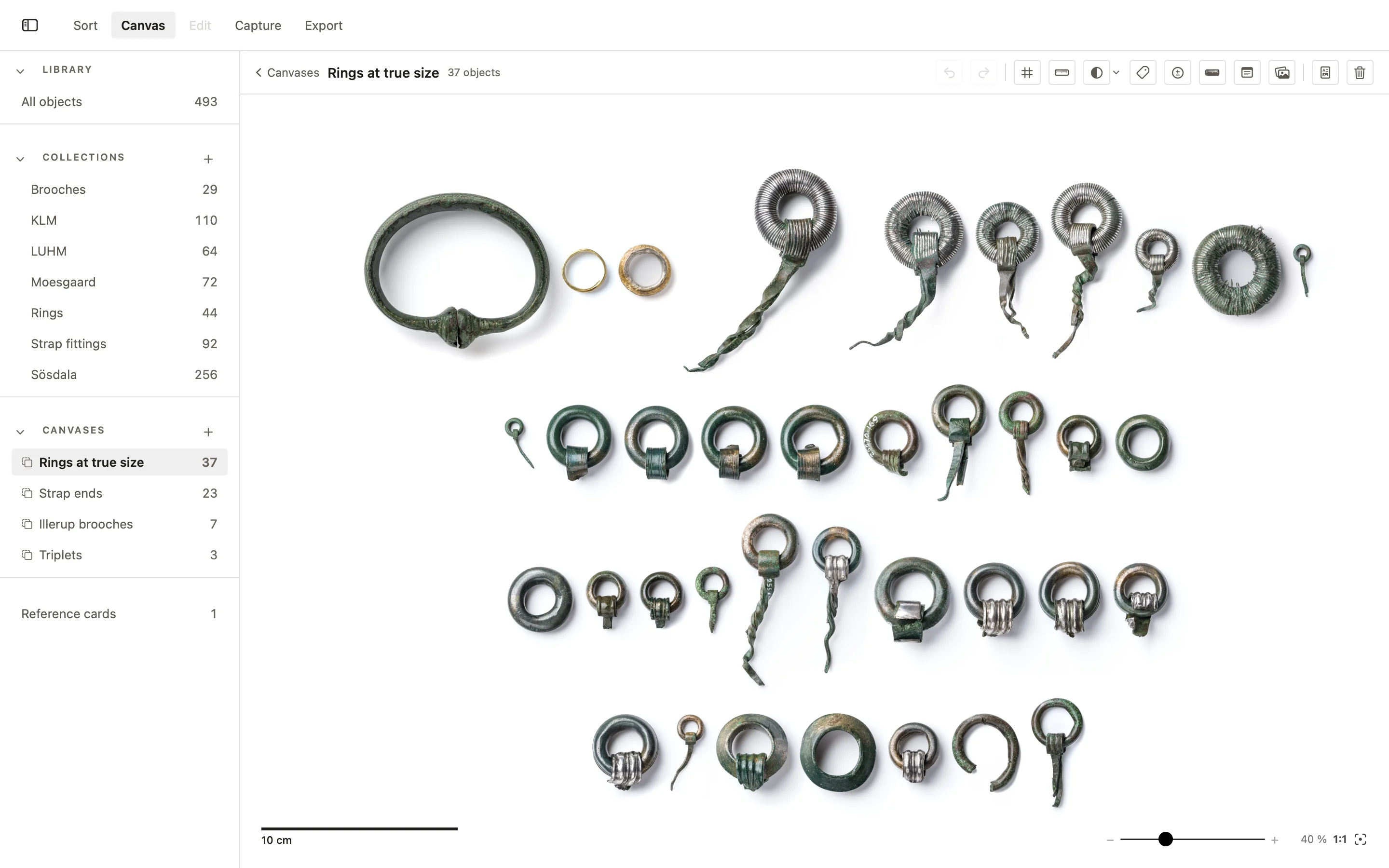
Lay objects out at their real size, turn them, annotate them, measure them and save the canvas as a PDF at true scale, to print or share.

Edit in the PHOTARCH app

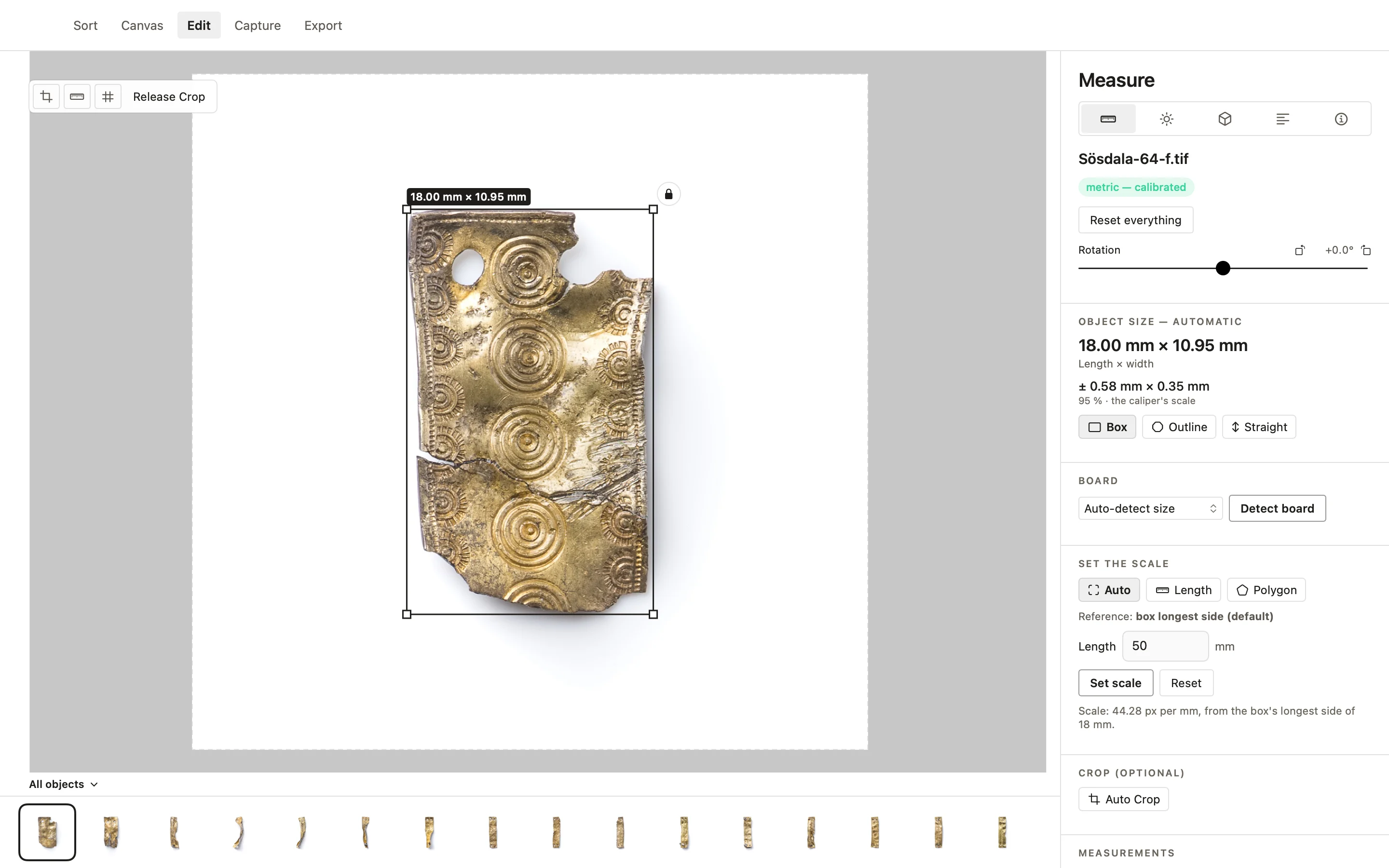
Edit

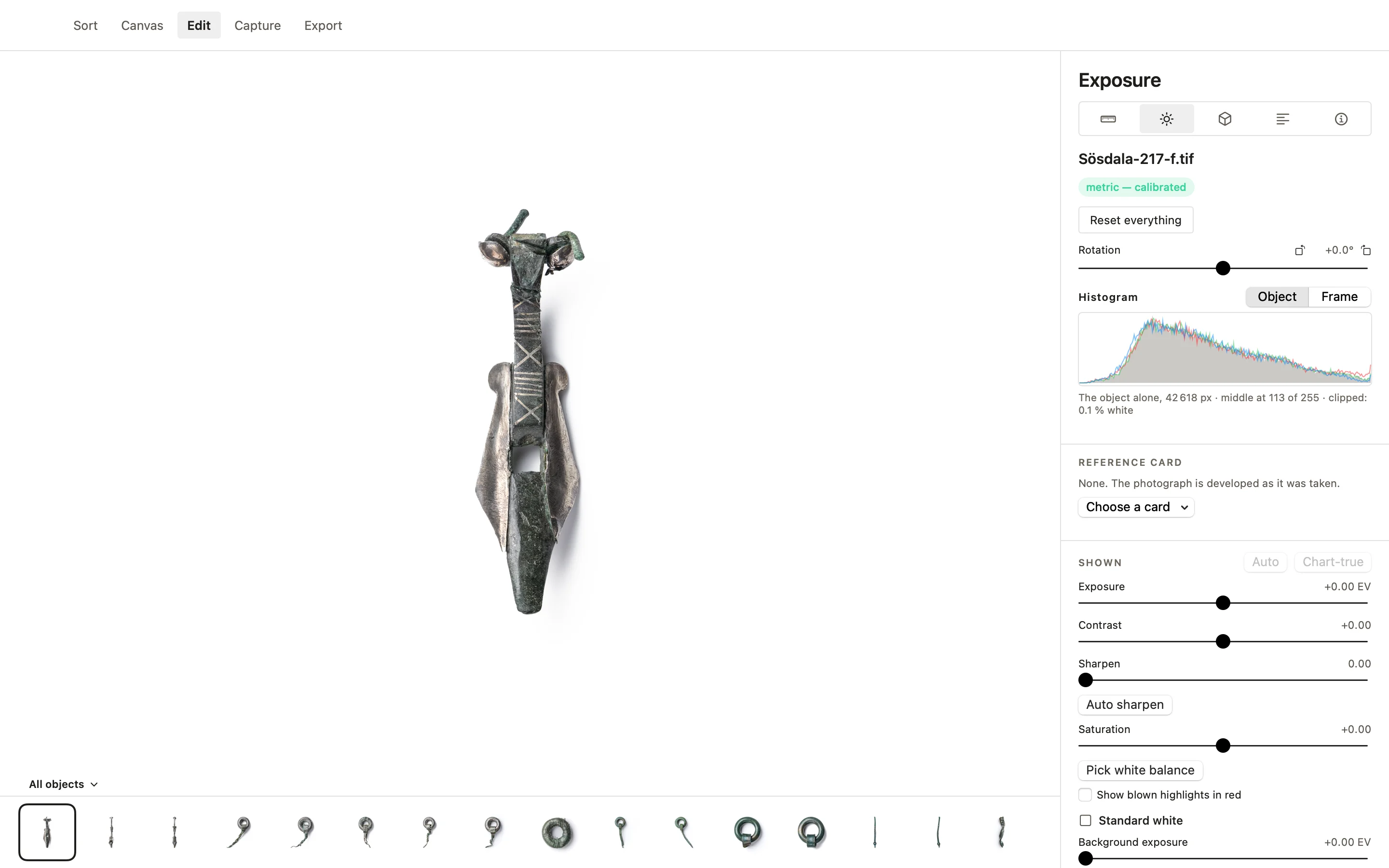
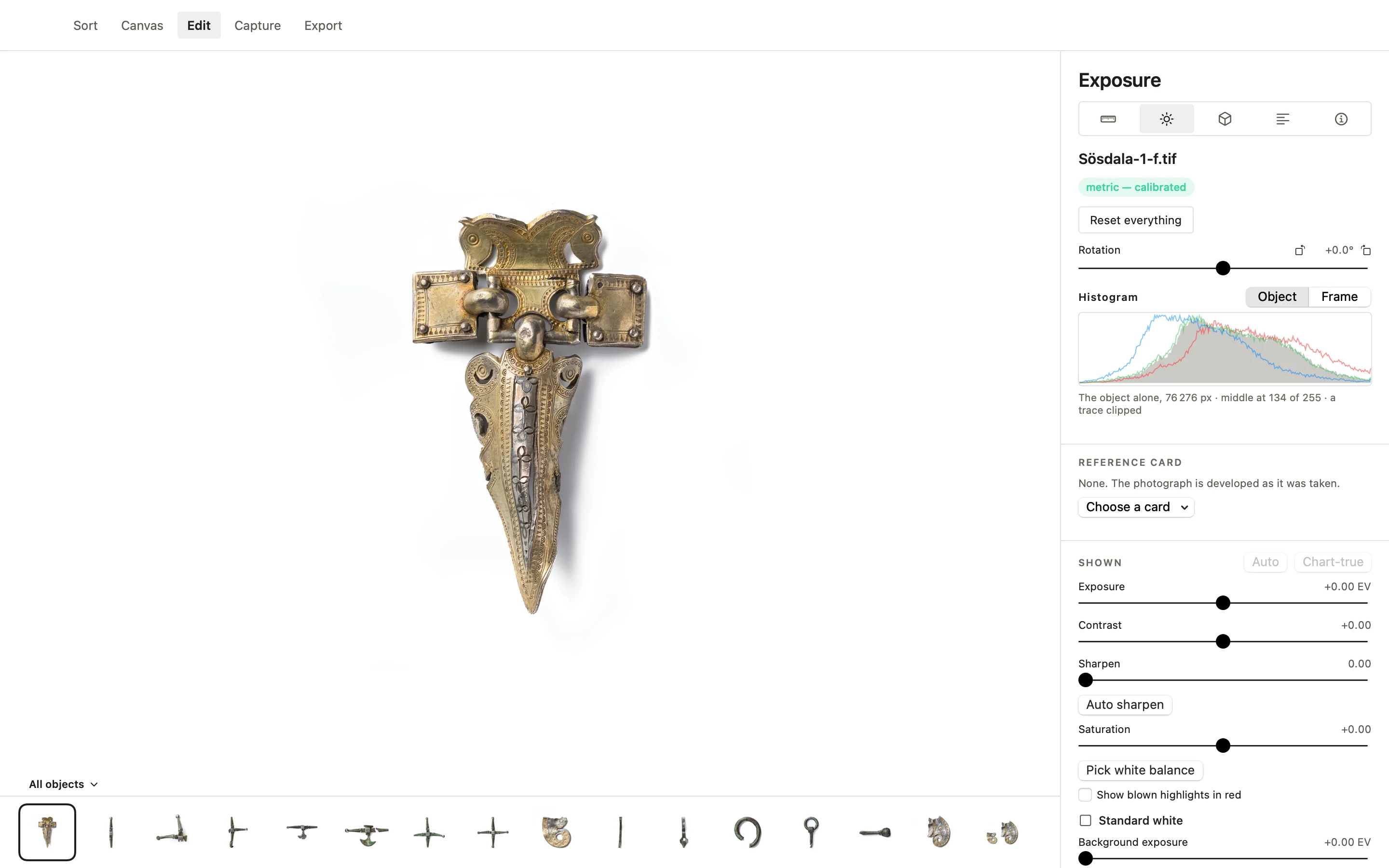
One object at a time: its scale and its size in millimetres, the board and the ColorChecker, the histogram, development, the record and notes pinned to the picture, with what the picture is fit for. The master is never altered.

Capture in the PHOTARCH app

Capture

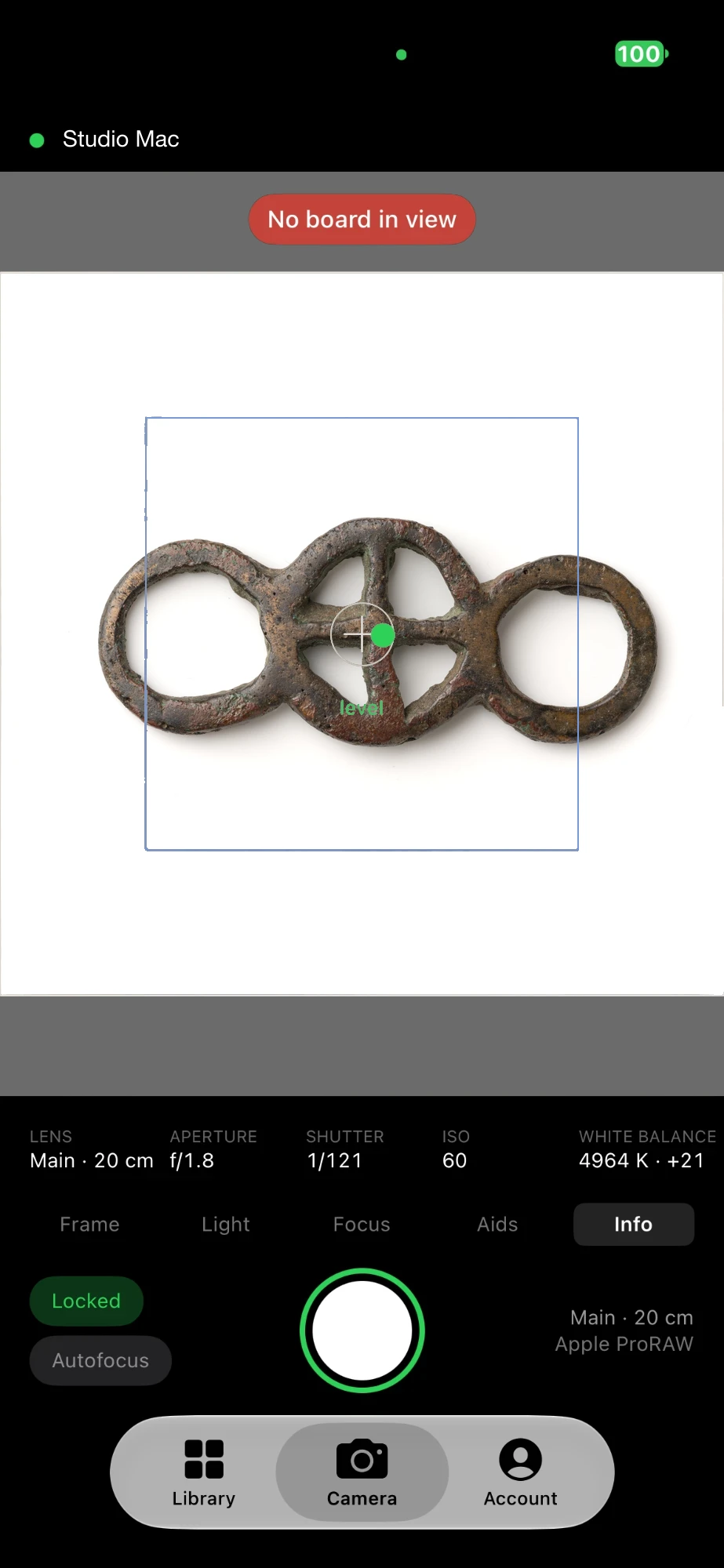
Shoot with PHOTARCH for iPhone, over Wi-Fi or a cable, straight into the catalogue — with exposure warnings and focus peaking in the viewfinder, and three lights, Sharp, Exposure and Board, that say whether the frame is worth taking. In an organisation, several photographers can photograph into the same library, one phone connected at a time.

Print in the PHOTARCH app

Print

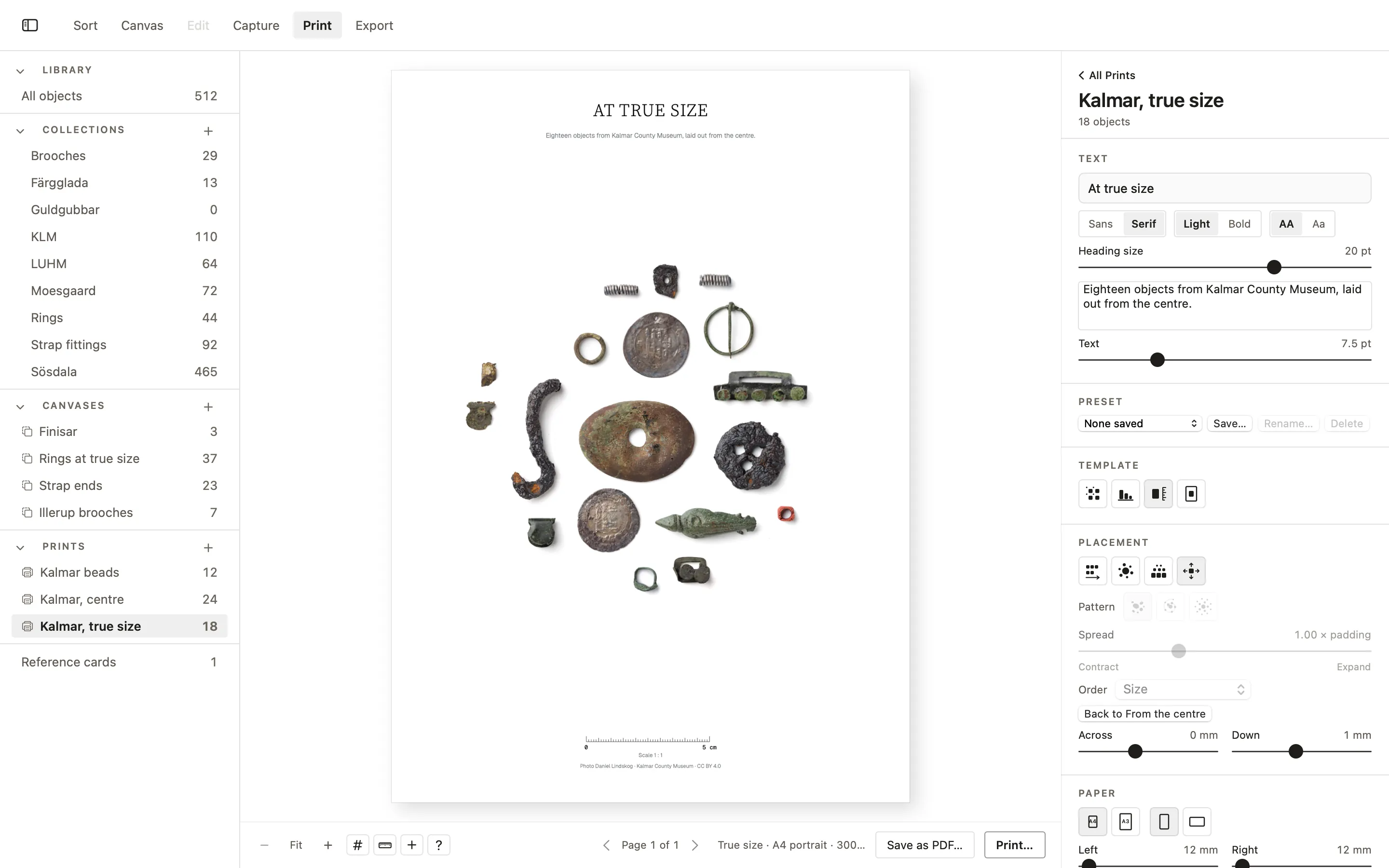
Lay chosen objects out on A4 or A3 at their measured scale: a numbered plate with its list of captions, all at one scale, at true size, or one object to a page — in rows, from the centre, from the bottom or exactly where you drop them. A scale bar, captions from the record and the photo credit go on the page; prints are saved like canvases, and leave as a PDF at 300 ppi with bleed and crop marks for a printer.

Export in the PHOTARCH app

Export

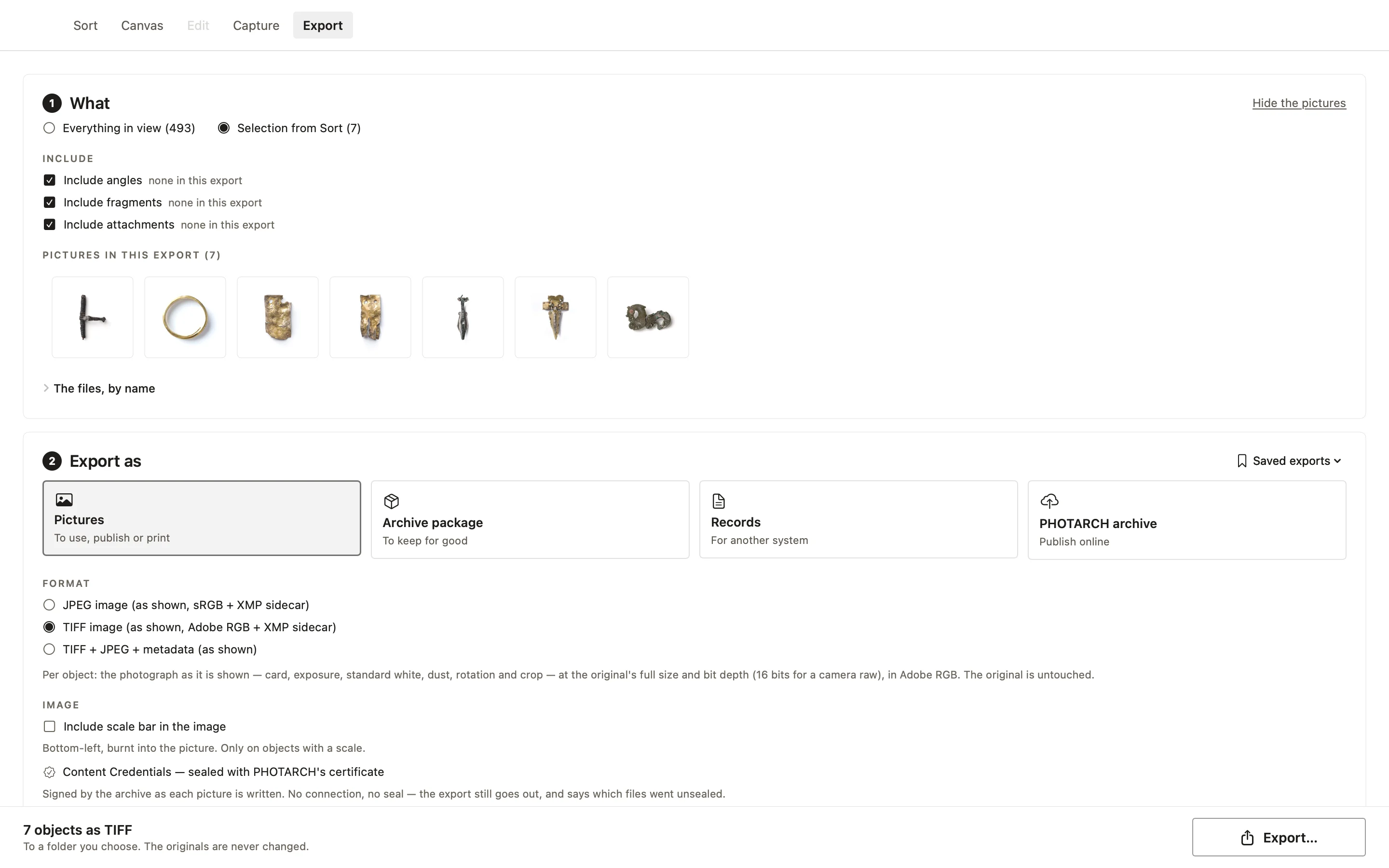
A package, TIFF or JPEG with the record, the true scale and the rights written into the file. Free marks each picture with a small PHOTARCH mark; Private exports without it, and adds CSV and Dublin Core records. Organisations get every format — LIDO, JSON-LD, Web Annotation and Europeana EDM.

Features

One app, from the shutter to the archive. Everything here is in every level, Free included, unless a row is marked with the levels it is for. Open a row to see it.

  • CaptureShoot with PHOTARCH for iPhone, over Wi-Fi or a cable, straight into the catalogue — with exposure warnings and focus peaking in the viewfinder, and three lights, Sharp, Exposure and Board, that say whether the frame is worth taking. In an organisation, several photographers can photograph into the same library, one phone connected at a time.
    Capture in the PHOTARCH app
  • Shoot tethered with a mirrorless cameraPrivate and OrganisationPlug a Sony camera into the Mac with its USB cable and photograph straight into the library, with the live view and the board check on the Mac’s screen. Focus, zoom, shutter speed, aperture, ISO and white balance are set from the app, Expose for Board sets the exposure from the board, and the original is kept on the Mac, on the camera’s card or on both, in RAW or JPEG.

    These are the cameras Sony’s Camera Remote SDK controls over USB. Tethered capture has so far been tried on the α7 IV only; the others are on Sony’s list and are expected to work, but have not yet been tried. Sony’s terms for controlling its cameras are shown, and accepted, before a camera is first used.

    • α1
    • α1 II
    • α9 II
    • α9 III
    • α7 IV — tried
    • α7 V
    • α7C
    • α7C II
    • α7CR
    • α7R IV
    • α7R IVA
    • α7R V
    • α7R VI
    • α7S III
    • α6700
    • FX2
    • FX3
    • FX3A
    • FX30
    • ZV-E1
    • ZV-E10 II
    • RX0 II
    • RX1R III
    • ILX-LR1
  • ImportDrag in files and folders, or watch a folder. Originals stay where they are, and nothing is ever written over.
    Import in the PHOTARCH app
  • SortA grid of every object on white, with ratings, flags, colour labels and keys for culling, search and filters. Search by colour too: pick a colour on the wheel and see every object that has it — the colours the object is mostly made of, measured, not guessed.
    Sort in the PHOTARCH appColour search in the PHOTARCH app: the colour wheel over the grid
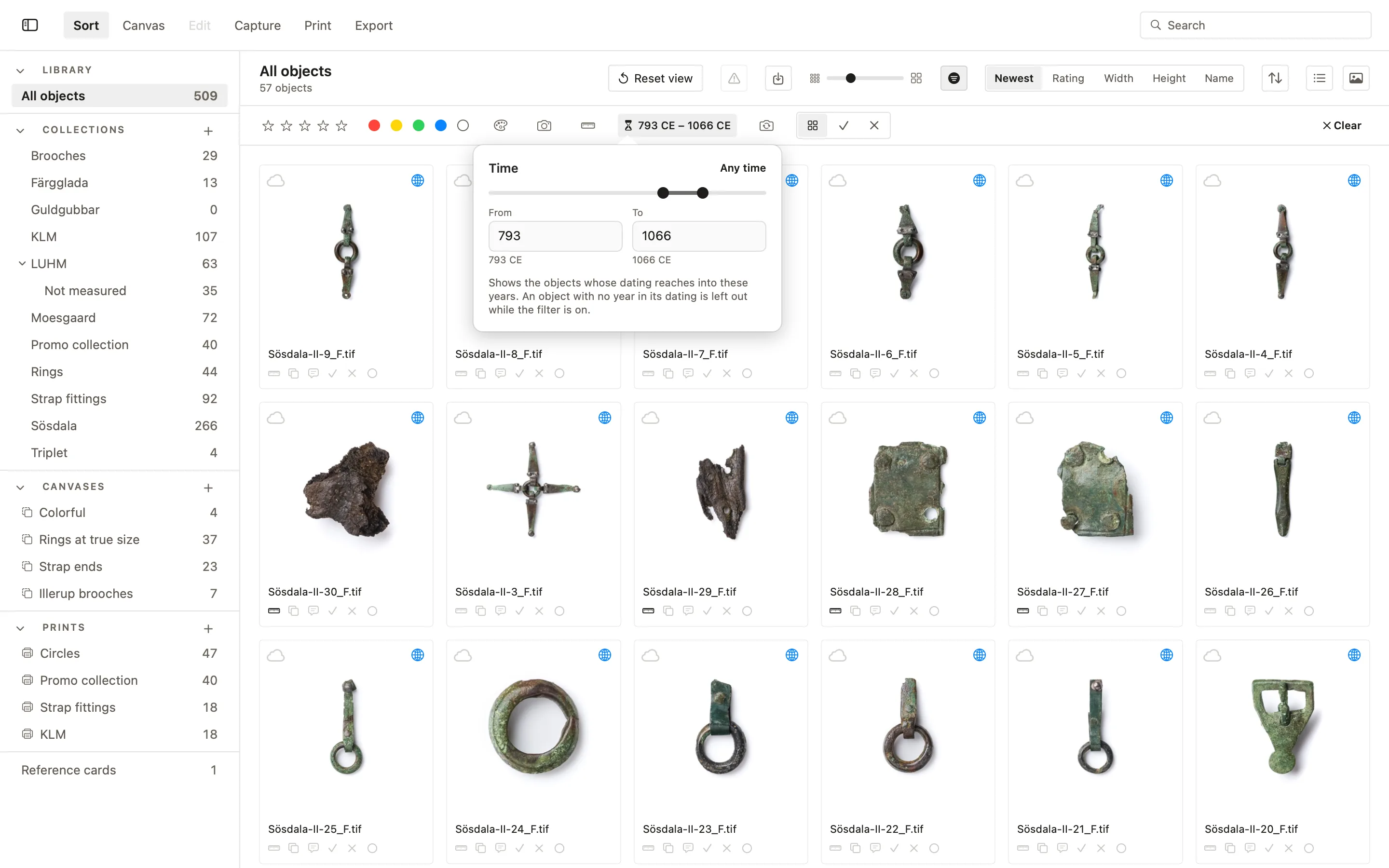
  • Sort through timeSet a start and an end on a slider and Sort shows the objects whose dating reaches into those years: the Iron Age on one screen, the twelfth century on the next. Drag the ends or type the years, before and after the common era alike. The track spans what your own library has dated.
    Sort through time in the PHOTARCH app
  • FragmentsA broken object can be handled two ways. Each piece can be an object of its own, marked as a fragment, or the pieces can be linked into one group, shown as one card. Put them on a canvas and move them until they fit.

    Try it: drag the three pieces together.

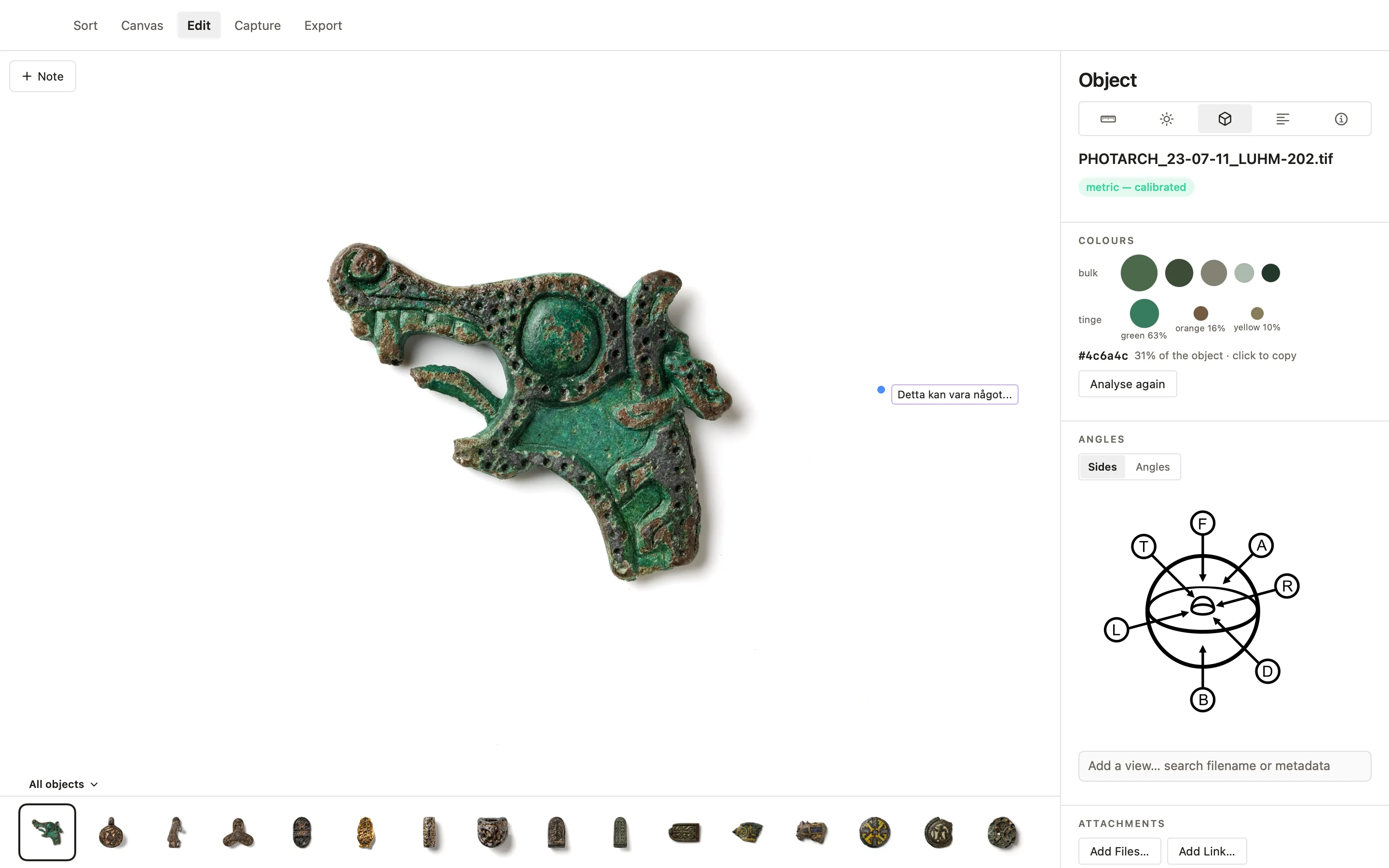
  • AnglesEvery object has one main picture, the plumb view taken straight down. Its other views — the sides, the underside, angles from above, close-ups — stay pictures of the same object, each measured on its own, and each is named on a drawing rather than picked from a list.

    Try it: drag the sphere to turn it. Click a name, and its picture is marked; click a picture, and its name is.

  • CollectionsA tree of collections with their own metadata and presets, filled into every object imported into them.
    Collections in the PHOTARCH app
  • View at scaleObjects shown at their true size relative to one another, with a scale bar.
    View at scale in the PHOTARCH app
  • MeasureScale from the object’s longest side, measured with a digital caliper, or read from a ruler in the picture; the object’s box and area in millimetres, and what each picture is fit for — a record shot, a study or a reproduction — with what keeps it from the next. For flat originals, FADGI, ISO 19264-1 and Metamorfoze can be turned on.
    Measure in the PHOTARCH app
  • Board and markersThe calibrated alternative to the caliper. Lay the object on the PHOTARCH board and the PHOTARCH app finds the markers in its corners — they lie in the object’s own plane — reads the scale and corrects the perspective in one step. No board yet? Print the marker sheet from the app on any printer, check it against the control ruler printed on it, and Detect board uses it as a board of your own.
    Board and markers in the PHOTARCH app
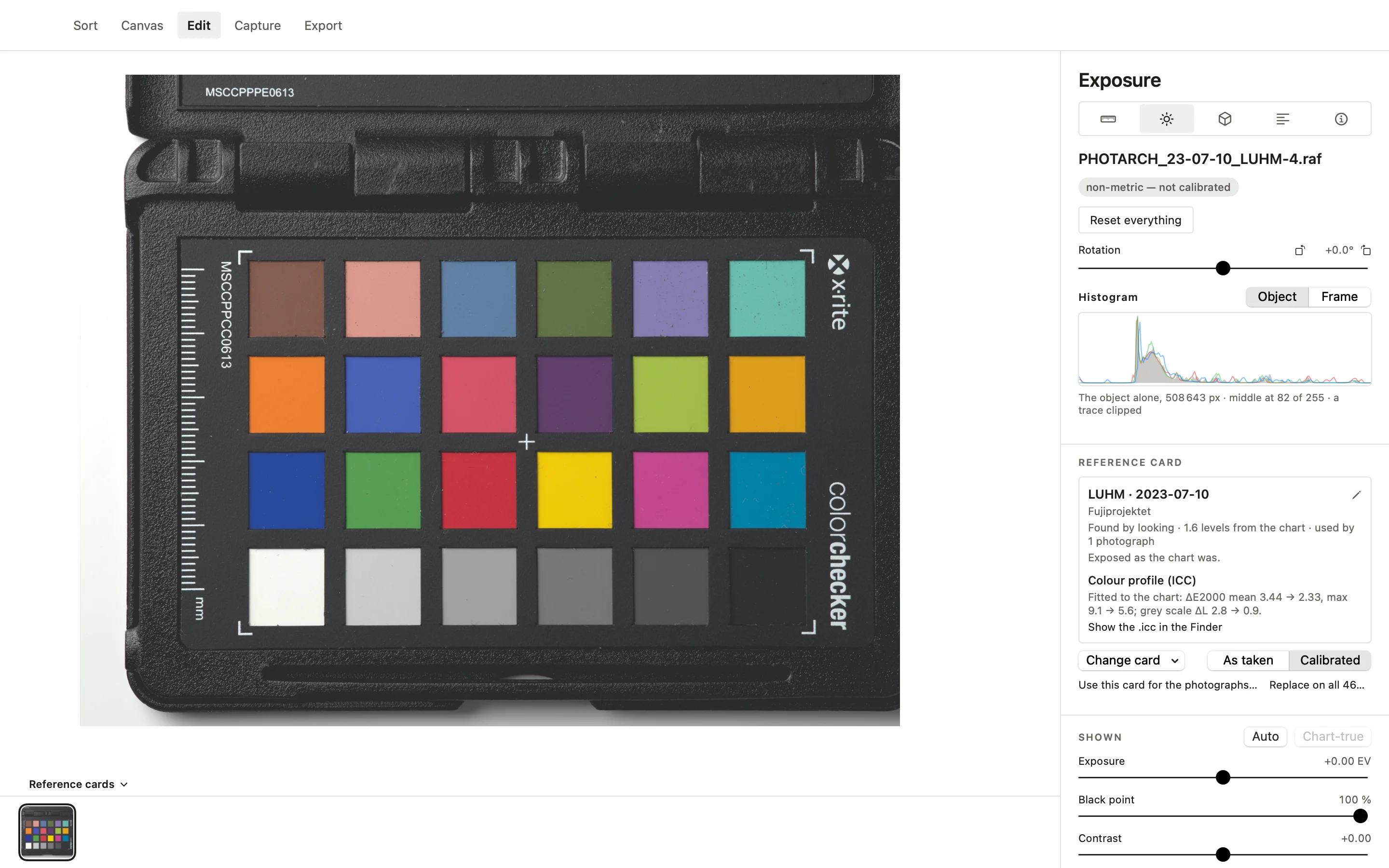
  • Color CheckerThe ColorChecker that opens a sitting is found and read with one click. Its published values set the white balance, exposure and black point of the photographs in its sitting — one more click gives the card to all of them — and an ICC colour profile can be fitted to its 24 squares and travels with the package. Colour accuracy before and after is measured as ΔE 2000, the mean and the 90th percentile over the card, which is what a study and a reproduction are judged on.
    Color Checker in the PHOTARCH app
  • DevelopDocumentary correction: exposure, a square crop, rotation and PHOTARCH background, which gives every picture the same white ground, and a few presentation settings kept beside the calibration — the master itself is never altered.
    Develop in the PHOTARCH app
  • HistogramThe object’s own exposure, not the white ground around it, with what is clipped in black and in white.
    Histogram in the PHOTARCH app
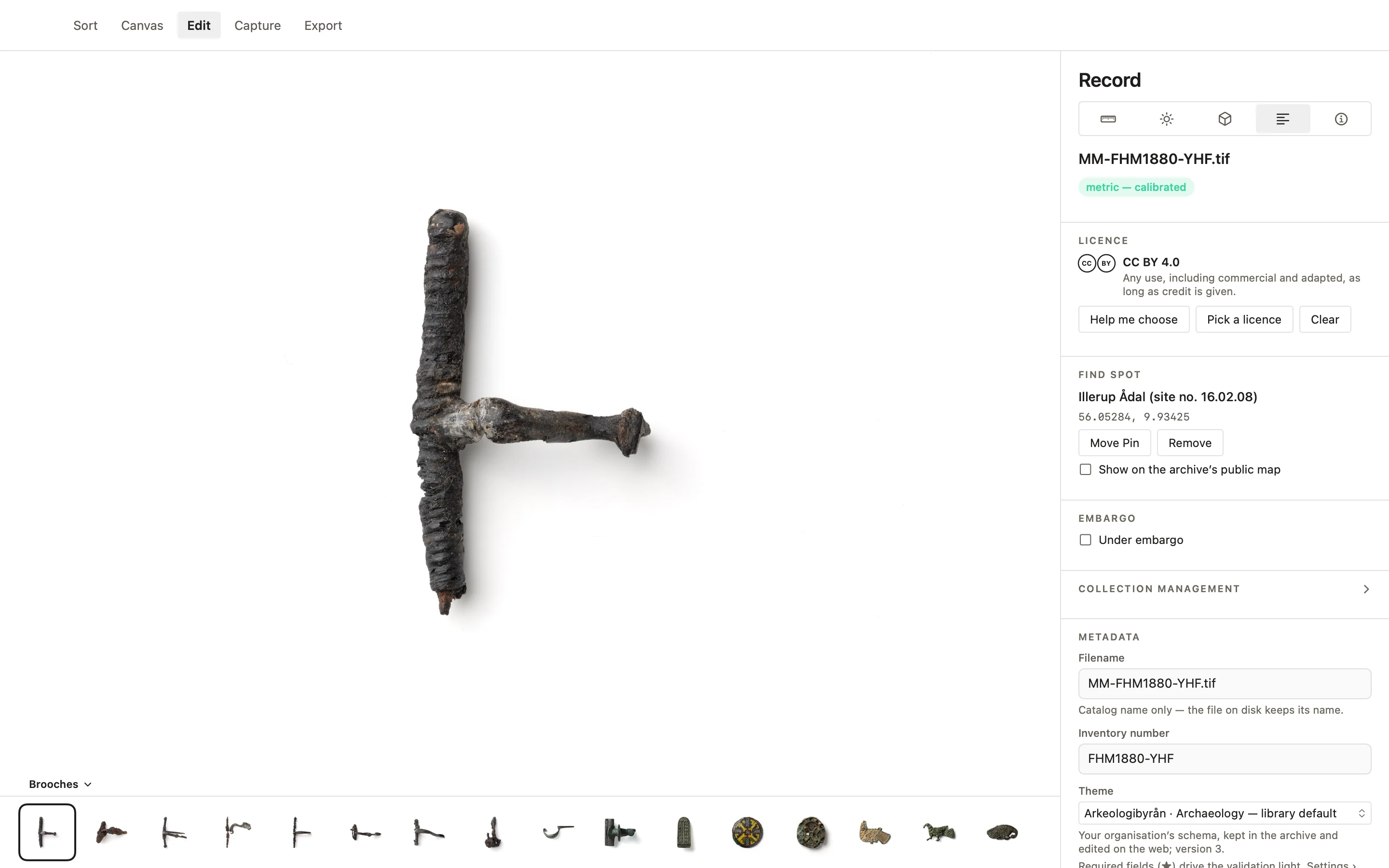
  • MetadataControlled vocabularies, the organisation’s own fields, and import of existing records from CSV, JSON-LD and Dublin Core.
    Metadata in the PHOTARCH app
  • NotesNotes pinned to a point on the picture, and a private note per object.
    Notes in the PHOTARCH app
  • AttachmentsAnything that belongs beside the photograph travels with the object, and can be made public one by one.
    • —Older photographs
    • —Drawings
    • —Scans
    • —Reports
    • —Notes
    • —3D models

    Try it: this is a 3D model attached to an object. Drag to turn it.

  • CanvasLay objects out at their real size, turn them, annotate them, measure them and save the canvas as a PDF at true scale, to print or share.
    Canvas in the PHOTARCH app
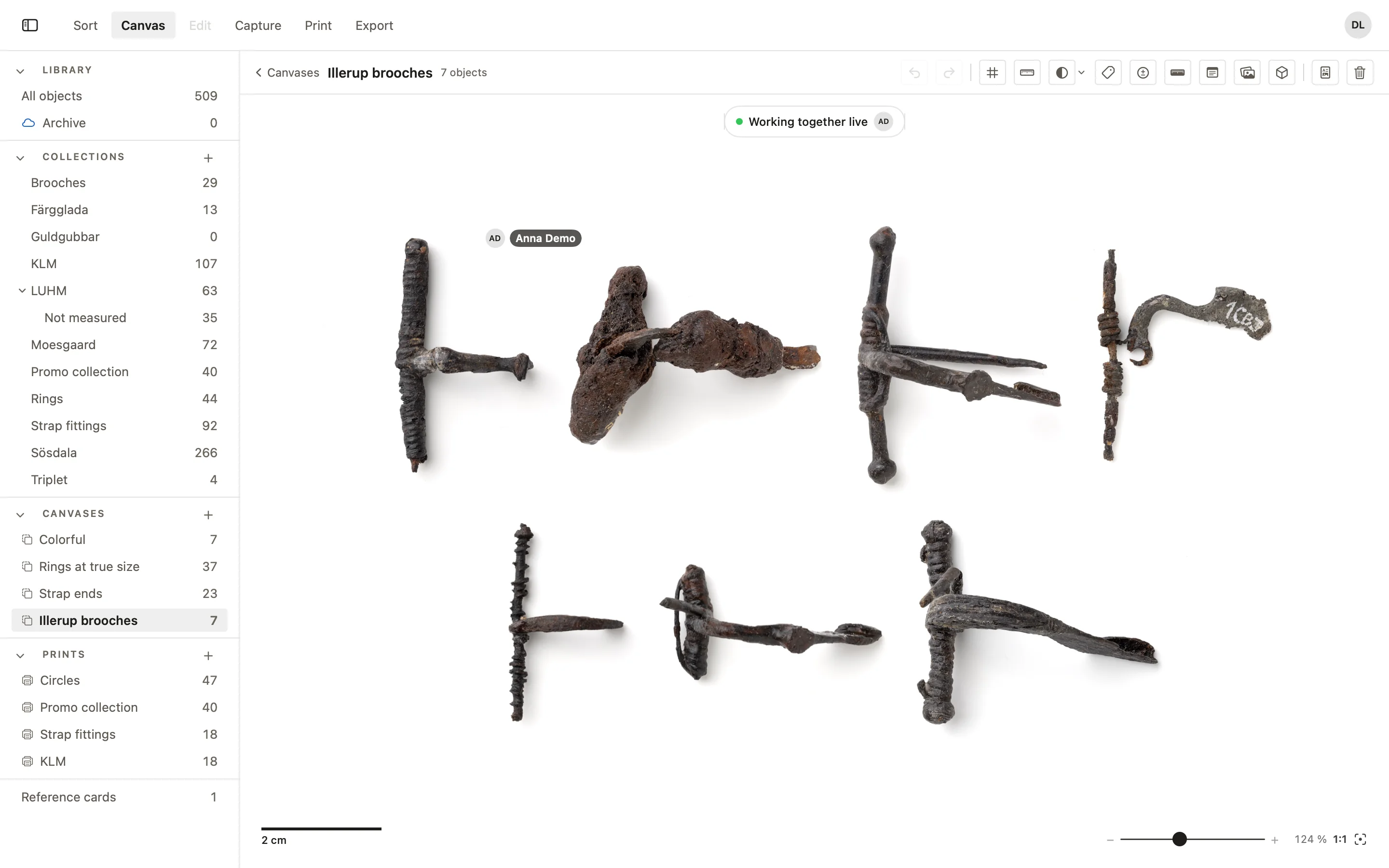
  • 2D + 3D, together at lastA photograph and a 3D model side by side on one canvas: the flat picture, and the form it cannot show. They share one plane in millimetres, so a measured model stands at true scale beside the photograph; one that has not been measured is marked as such.
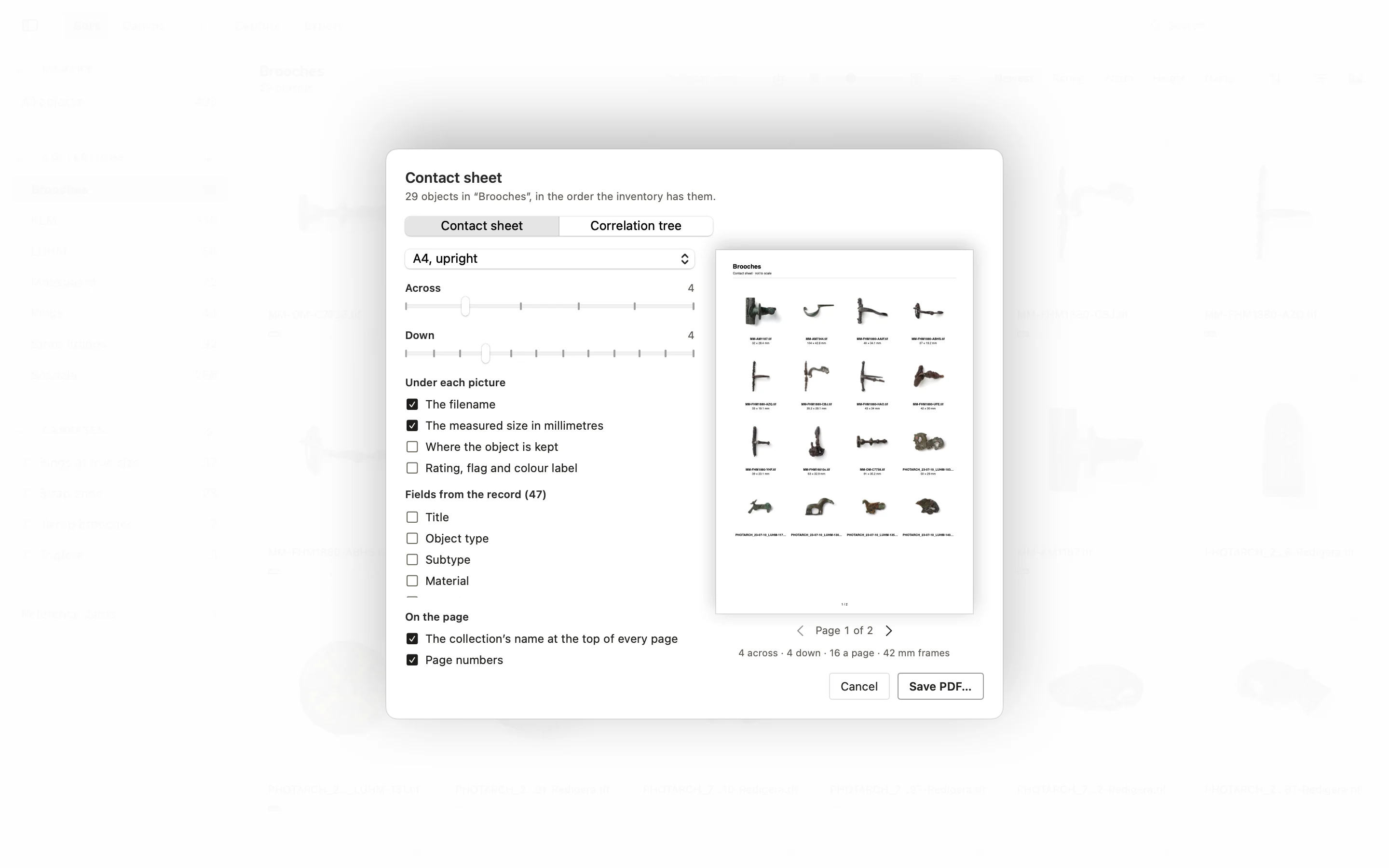
  • Contact sheetA PDF contact sheet of a collection or a storage place, laid out to your choice, with sizes and where each object is kept.
    Contact sheet in the PHOTARCH app
  • PrintPrivate and OrganisationLay chosen objects out on A4 or A3 at their measured scale: a numbered plate with its list of captions, all at one scale, at true size, or one object to a page — in rows, from the centre, from the bottom or exactly where you drop them. A scale bar, captions from the record and the photo credit go on the page; prints are saved like canvases, and leave as a PDF at 300 ppi with bleed and crop marks for a printer.
    Print in the PHOTARCH app
  • Augmented realityIn PHOTARCH for iPhone, place an object in the room at its measured size and walk around it — or a whole canvas, laid out on a table as it was arranged.
    iPhone 18 Pro
  • ExportA package, TIFF or JPEG with the record, the true scale and the rights written into the file. Free marks each picture with a small PHOTARCH mark; Private exports without it, and adds CSV and Dublin Core records. Organisations get every format — LIDO, JSON-LD, Web Annotation and Europeana EDM.
    Export in the PHOTARCH app
  • Physical archiveOrganisation onlyGive every shelf and box a small QR label. Point PHOTARCH for iPhone at it and see what is inside, move an object to another box on the spot, and have the move recorded in the object’s history. The labels show only a number unless you choose otherwise, and only your own PHOTARCH app can open them. Your photographs and records stay on your own computer; the organisation can choose to share its store map — the places and what stands where — so every computer sees the same one, never the pictures, the records or a find spot. Builds on the storage levels and the Location & movements procedure in collection management. The objects of a collection or a place can be exported as a correlation tree: every place they are kept in, and the objects in each.
    Physical archive in the PHOTARCH app
  • CollabPrivate and OrganisationWork on a collection or a canvas with colleagues at other institutions, each in their own PHOTARCH app. It is sealed on your Mac, end to end, for the people you invite: PHOTARCH relays it without being able to read it. Choose what goes — the record, measurements, notes, attachments, find spots, storage places — and for how long. Their changes come back as suggestions to accept field by field; on a canvas you can also work together live, and see each person’s avatar by the object they move. A colleague you invite needs only a PHOTARCH account and the app.
    Collab in the PHOTARCH app
  • Researchers togetherOrganisation onlyMany researchers can work under one organisation. Notes can be shared with the whole organisation, and collections and canvases in the web archive by private link. Several can work on the same objects, each in a library of their own.
    Researchers together in two computers in one organisation
  • Archive and SyncOrganisation onlyPublish to the PHOTARCH archive when the organisation chooses, and keep it in step afterwards — only what changed is sent. Private users keep everything on their own computer.
    Archive and Sync in the PHOTARCH app
  • EmbedOrganisation onlyPut a collection or a canvas on the organisation’s own website. Start from a layout — a gallery, objects side by side at true scale, a catalogue, a strip, or a canvas as it was arranged — then set the columns, background, captions, shadow and scale bar in a live preview, and paste one line of code. An embed shows what the organisation has published in the PHOTARCH web archive: publish the objects there first, and the embed follows every change.
    Embed in the PHOTARCH web archive
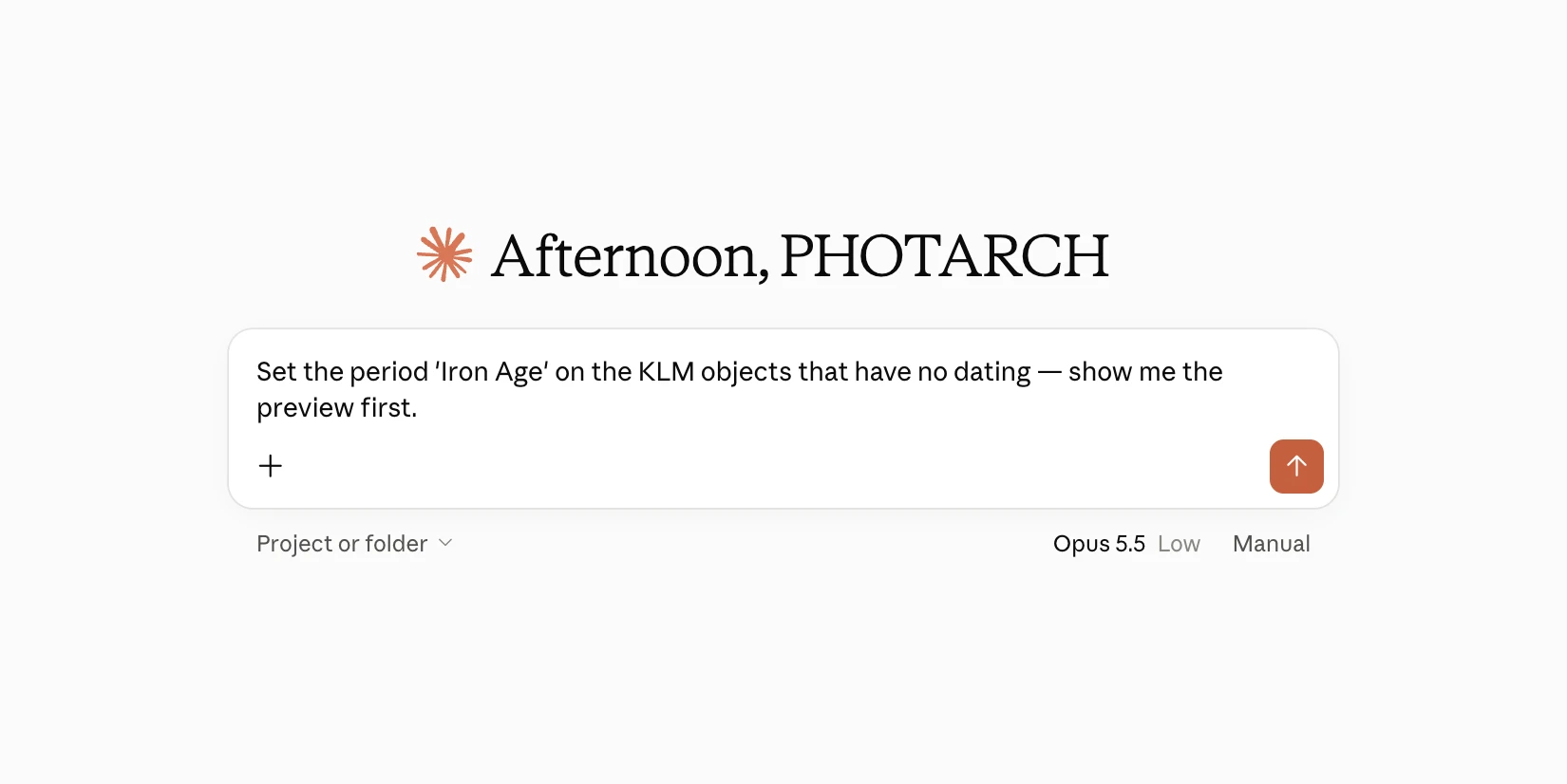
  • AI adminOrganisation onlyLet the organisation’s own AI tool work on the app’s library: search it, see what is missing, put records right, set licences, sort objects into collections and places, and publish to the archive. The AI runs at your own AI service, on your own account and tokens; PHOTARCH runs no AI. A change to many objects, and anything that reaches the archive, is shown first and made only when a person approves it in the PHOTARCH app, and everything a session changed can be taken back at once while the app stays open. Hidden find spots and internal notes are sent to the AI only when you say so.
    AI admin in Claude, an AI tool

04 — Print · Private and Organisation

Objects on paper, at the scale they were measured

Choose objects in Sort and the Print page lays them out on A4 or A3 — at true size, or all at one scale with a scale bar beside them. Save it as a PDF for a printer, or print it.

The Print page in the PHOTARCH app: the print Circles, forty-seven objects laid out from the centre in rings on an A3 page at scale 1 : 2, with a scale bar, and the settings for text, template, placement and paper beside it

Four templates, four placements

The template says what the page is; the placement says how the objects lie on it. The page is drawn again as each setting changes, and margins, the air between objects and their size are set with sliders.

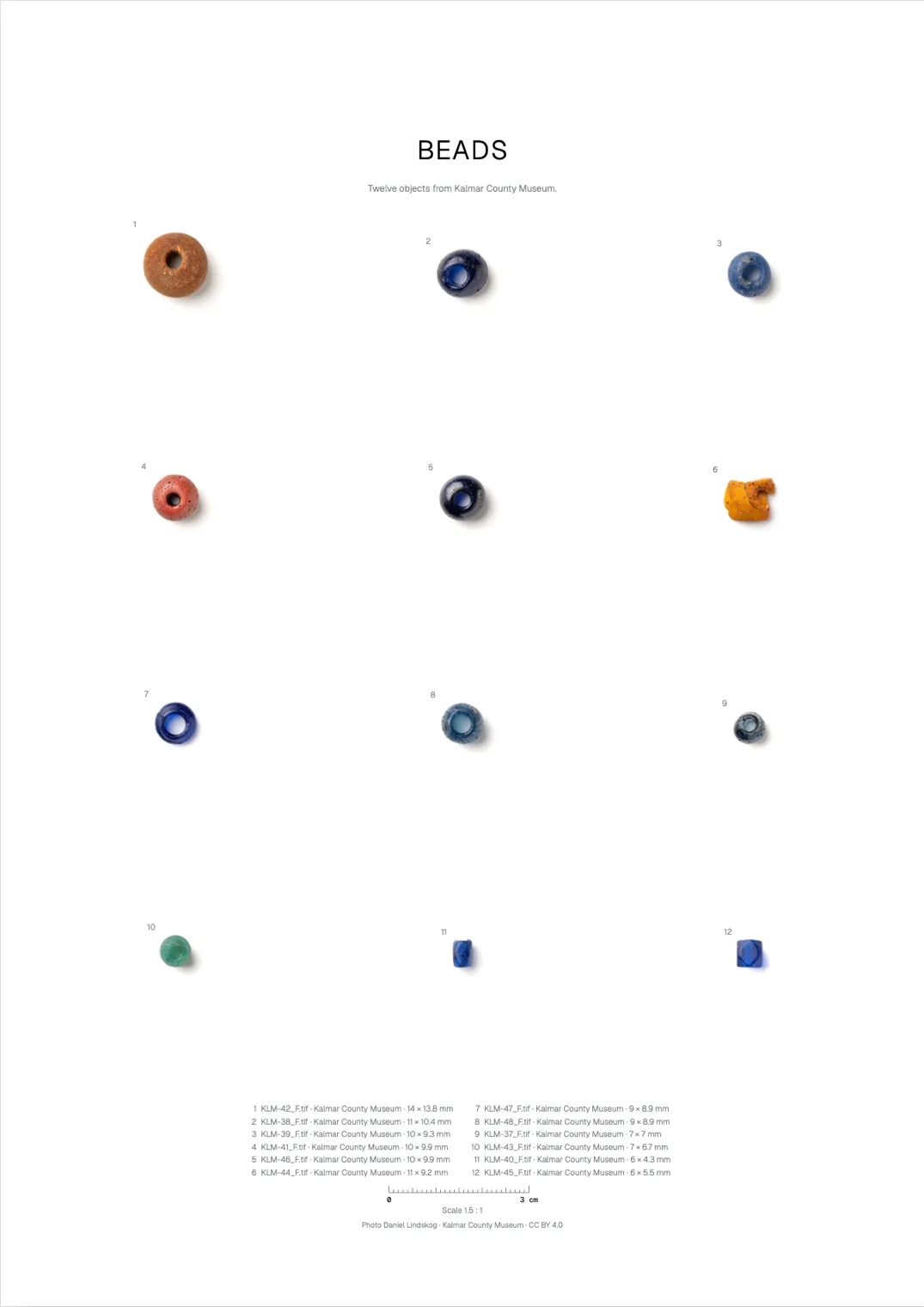
A printed Plate on A3: twelve beads from Kalmar County Museum numbered in a grid at scale 1.5 : 1, with a list of captions and sizes, the photo credit and a scale bar
Plate
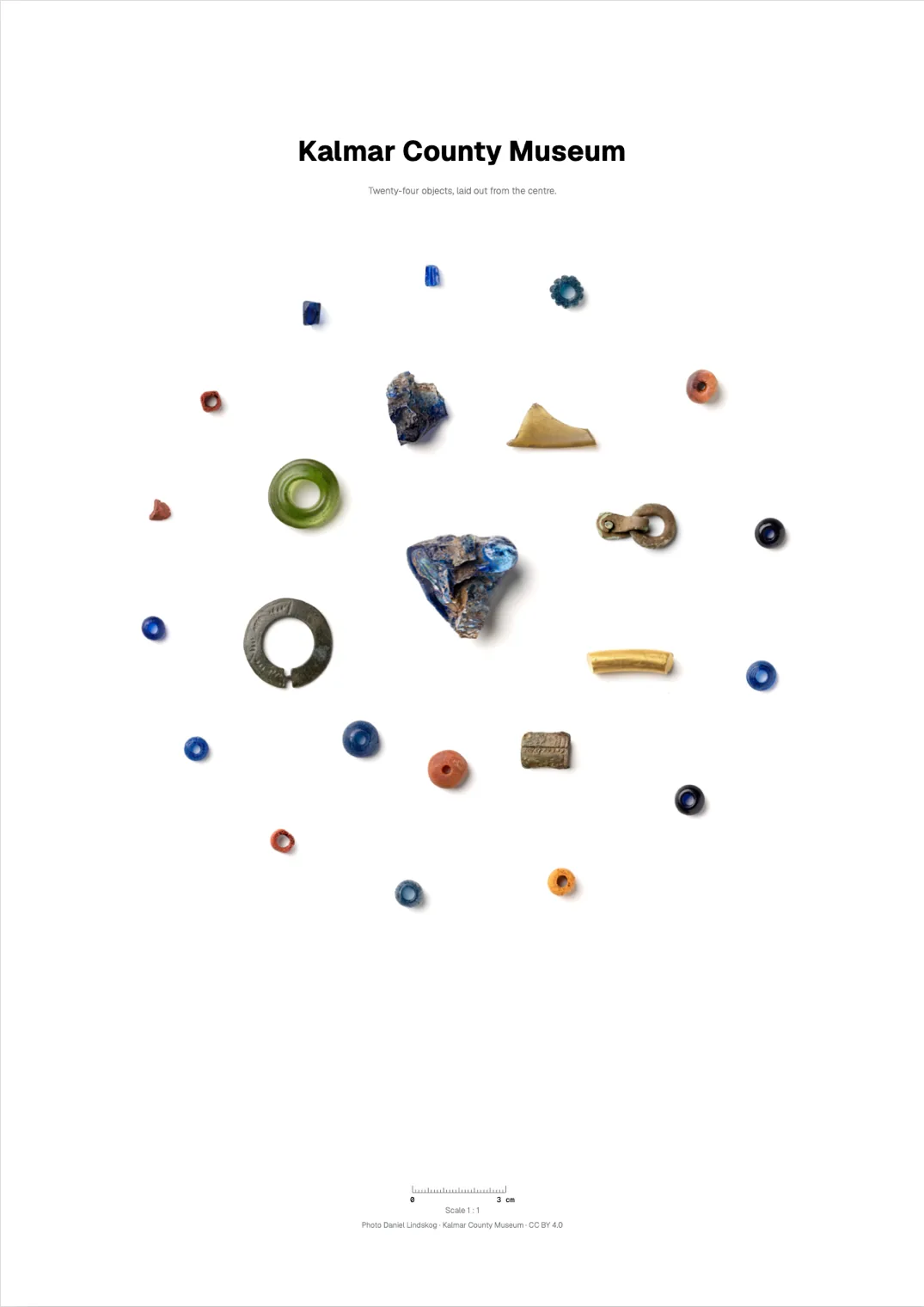
A printed page on A3: twenty-four objects from Kalmar County Museum at true size, laid out from the centre in the Rings pattern, with a scale bar and the photo credit
From the centre, Rings pattern

Kept like a canvas

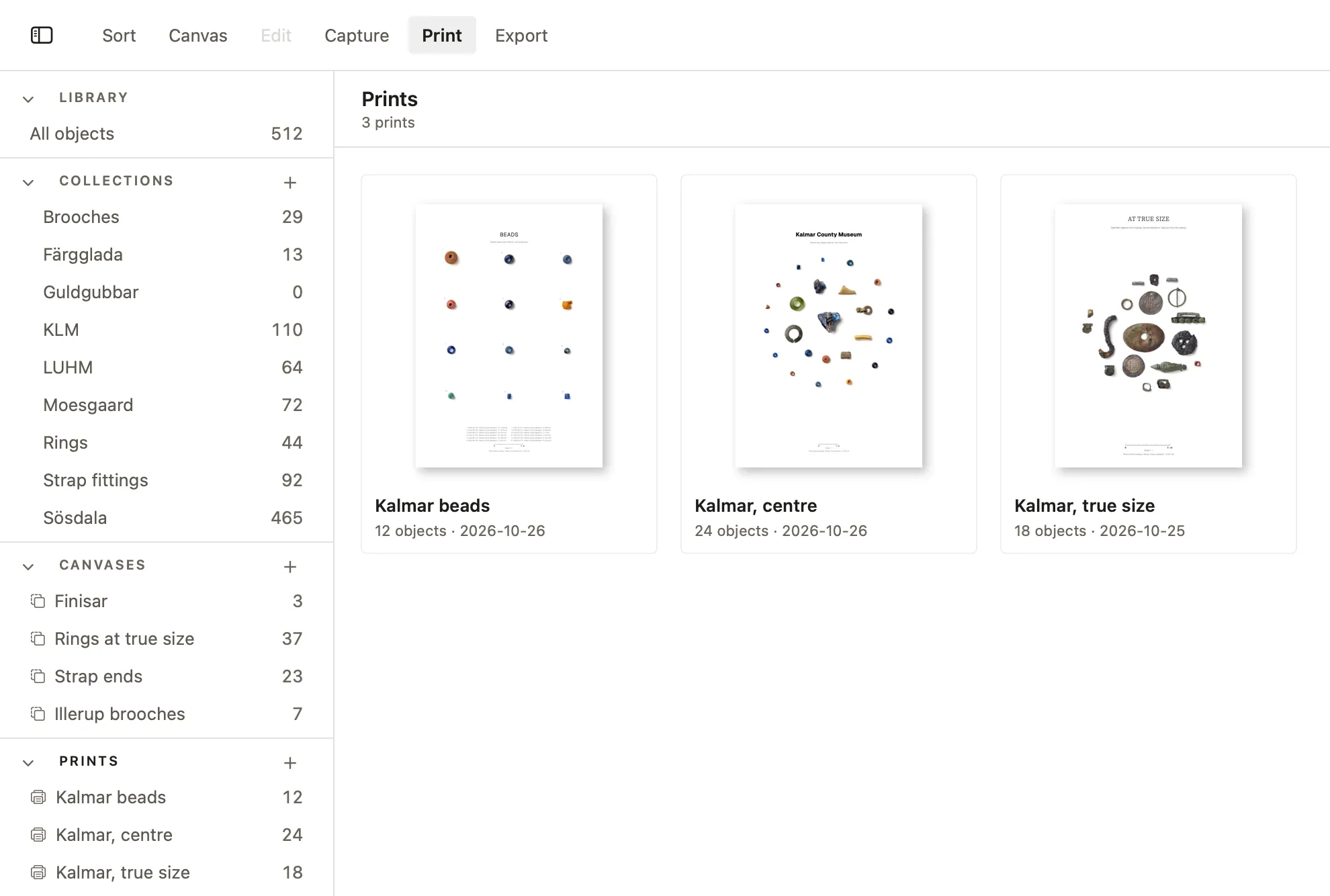
New Print makes a print in the library at once, and every change is saved as it is made. The Print page opens on a gallery of them, and they are listed in the sidebar beside the canvases. Use Layout as Template starts the next print with the same settings for another choice of objects.

The gallery of saved prints in the PHOTARCH app, with the prints also listed in the sidebar under Prints

Templates

Plate: the objects numbered, with a list of captions under them. Same scale: every object on one page, at the one scale that fits them all. True size: one to one, on as many pages as it takes. Single: one object to a page, large, with its full caption.

Placement

Linear, row by row on a common line, ordered by height, length, size or the order they were chosen in. From the centre, the largest in the middle, as Organic, Spiral or Rings. From the bottom, the largest at the foot. Or Free: each object exactly where it is dropped.

On the page

A scale bar or a ruler, a heading and a few lines of description, captions taken from the record — title, inventory number, museum and sizes, each chosen on its own — the photo credit, and a footer. A key sheet can go with it: an A4 with each object as a numbered black silhouette where it lies, and the list under them.

For the printer

A PDF at the paper’s real size, the pictures at 300 ppi in sRGB. The app says which objects would print below 300 ppi rather than enlarging detail that is not there. Bleed of 3 mm and crop marks when a printer asks for them.

Free to bring in from the archive

Every object published in the PHOTARCH web archive can be brought into your own library in the app, at no cost and at every level: sign in with a free account, open Whole Archive and bring an object down, with its record and its measured scale. On Free the library holds 100 objects. PHOTARCH’s own photographs are CC BY 4.0, free to use and to print with credit to the photographer and the museum. Making prints from them in the app takes Private or Organisation.

05 — AI admin · Organisation only

Your own AI, working on your library

An organisation can let its own AI tool work on the library in the PHOTARCH app: search it, see what is missing, put records right, set licences, sort objects into collections and places, and publish to the archive.

The AI runs at your own AI service, on your own account and tokens.*

Claude, with a request to the PHOTARCH app typed in plain words: set the period Iron Age on the KLM objects that have no dating, and show the preview first

It stays on the Mac

Your AI tool reads and changes the library through a connection that stays on the Mac. What the tool reads is processed by its provider under your own account with them, not by us.

What it can do

Read everywhere; change only on the organisation’s cataloguing computer. It writes only the record’s own fields, a fixed list’s values from that list, and a licence from the fourteen statements the archive accepts.

Taking it back

Everything a session changed can be taken back at once while the app stays open: ask your tool to undo the session, or press Take Back … Changes in Settings › AI admin. A publication is taken back by withdrawing it.

* PHOTARCH runs no AI and pays for none; nothing is read or changed unless you ask your tool to. Works with Claude Desktop, added with one click from Settings › AI admin, and with other AI tools that run local MCP servers. ChatGPT reaches only servers on the internet, so it cannot use AI admin yet. The app has to be open while you work. Part of the organisation subscription.

06 — The organisation · Organisation only

One archive, many hands

Many researchers, one archive

Many researchers can work under one organisation. Notes can be shared with the whole organisation, and collections and canvases in the web archive by private link. Several can work on the same objects, each in a library of their own.

One computer holds the archive and catalogues into it; round it stand as many reading desktops as the organisation wants, each a researcher’s own library filled from the archive, which never writes to an original.

The physical archive

Give every shelf and box a small QR label. Point PHOTARCH for iPhone at it and see what is inside, move an object to another box on the spot, and have the move recorded in the object’s history.

The objects of a collection or a place can be exported as a correlation tree: every place they are kept in, and the objects in each.

Objects from Lund University Historical Museum and Moesgaard Museum · CC BY 4.0

The camera in your pocket

PHOTARCH for iPhone is the other half of the app. It is a camera of its own, free to download — and paired with the app on a Mac, over the local network or by cable, it becomes its shutter and live view: RAW, HEIF or JPEG, exposure warnings and focus peaking, and every picture straight into the library. In your pocket, the library goes with you, and an object — or a whole canvas — displayed through augmented reality.

iOS 17 or later. Works with every level of the app, Free included.

Download on

Download on theApp Store

07 — Who it is for

From a private collection to a national archive

Private collections

A single drawer or a lifetime’s gathering, kept in order and shown at true size.

Archives and stores

Every shelf and box known, and what is in them seen without opening them.

Museums and collections

Objects from any number of collections side by side, ready for the system already in use.

Research

Material from several organisations compared at one scale.

08 — Safety

A collection is kept for longer than any piece of software lasts

Nothing here depends on this company being around, on a network being up, or on a subscription being paid.

Your material stays on your machine

The PHOTARCH app keeps images, catalogue, measurements and metadata locally: your photographs and records stay on your own computer, and none of them is uploaded in the background. An organisation can choose to share its store map — the places and what stands where — so every computer sees the same one; never the pictures, the records or a find spot. What reaches the public archive is what you send there, when you send it.

The original is never altered

Every viewing version, tile and export is derived from the master, which is written once and left alone. A checksum is recorded when it enters, so the file you keep in ten years can be shown to be the file that came in.

Nothing is held hostage

A lapsed or unactivated licence falls back to the free tier. It always leaves your catalogue readable and your own data exportable — losing access to the software never means losing access to the work.

It keeps working offline

The licence is verified on the machine, not against a server, so the app runs in an archive with no signal and in the field with no network. Photographs taken without the computer queue on the phone and arrive when the two meet again.

Sensitive and embargoed material

Objects can be held back until they are ready to publish, and internal notes — shelf, location, accession number, condition — are never shown publicly.

No telemetry by default

The app sends no crash reports, and usage statistics are off unless you turn them on; they never include catalogue content, images or measurements. A data processing agreement is available for organisations that need one.

09 — Price

Buy it once. Or subscribe as an organisation

One app: the library on the Mac and the camera on iPhone. Every level carries the whole method — validation and measurement in millimetres. A private person buys the app once, as a tool; an organisation subscribes to the service around it — the archive, the team and the right to publish.

Free

0 €

No card, no time limit

Downloadfor Mac

Free membership, no credit card · macOS 14 or later, Apple Silicon

The app with every tool — the library on the Mac and the camera on iPhone — capped at one collection of 100 objects and one canvas. The web archive is open to everyone, without an account.

  • —One collection, 100 objects
  • —One canvas
  • —The iPhone as camera, within the cap: shutter and live view from the computer, straight into the library
  • —Your library in your pocket, and augmented reality at true size
  • —Validation: what each picture is fit for — record shot, study or reproduction
  • —Measurement in millimetres
  • —Scale from a digital caliper, or read from a ruler in the picture
  • —Colour from the ColorChecker
  • —Exports pictures: package, TIFF, JPEG
  • —Exported pictures marked “Processed by PHOTARCH”

Private

Once · updates for 12 months included

Ordinary price 100 €, introductory price 80 €

Introductory price until 31 December 2026; then 100 €. The app keeps working with the version you have after the 12 months

The app without the cap, for one person. A tool you own: it runs on your own computer and phone, and nothing is kept on our servers — unless you share a collection with Collab, and then only sealed, for the colleagues you invite. Bring in the photographs you have already taken — medium format, DSLR — and make them evidence.

Everything in Free, and

  • —No cap: unlimited collections, objects and canvases
  • —Exports without the “Processed by PHOTARCH” mark
  • —The record on its own: CSV and Dublin Core
  • —Print: objects laid out on A4 or A3 at their measured scale, as a PDF for a printer
  • —Collab: share a collection or a canvas with colleagues, sealed end to end

Organisation

Per month · billed yearly, by card or invoice

Ordinary price 150 €, introductory price 100 €

Introductory price for the first year, for organisations that sign before 1 January 2027 (code INTRO2026); then 150 € per month

The app for as many photographers as the organisation has, all working into one archive — and the right to publish in the PHOTARCH web archive. One computer holds that archive and catalogues into it; round it stand as many reading desktops as the organisation wants, each a researcher’s own library filled from the archive, which never writes to an original. The organisation’s admin sets the rules for how everyone works with the material: which collection-management procedures are used, and how the store is laid out — row, shelf, box, object. The app follows them for every photographer.

Everything in Private, and

  • —No limit on photographers
  • —One computer catalogues; no limit on reading desktops round it
  • —Admin page and team overview
  • —Hold material back until it is ready
  • —Add objects to the public archive, and keep them in step
  • —Every export format: LIDO, JSON-LD, Web Annotation and Europeana EDM
  • —Embed collections and canvases on your own site
  • —AI admin: your own AI tool working on the library
  • —Invoice, including Peppol
ONE COLLECTION · 100 OBJECTS

Free

0 €

The computer and the phone, capped at one collection of 100 objects.

Private

100 € once

The same app without the cap: your phone into your computer.

Organisation

150 € / month

One desktop holds the archive; the reading desktops stand round it, every photographer’s phone works into it — and from it, to the web.

The app on the computer is the archive; the phone photographs into the collection it has open, at every level. An organisation attaches as many phones as it has photographers, all working into the same archive — and publishes from it to the PHOTARCH web archive when it chooses.

Private is a personal licence, for one named person and their own devices. An organisation whose staff document its collection uses the organisation subscription. The camera app is free on the App Store, and it photographs on its own; paired with the app on a Mac — the free level included — it becomes its shutter and live view, and the pictures land straight in the library.

Prices exclude VAT. A Private licence can be refunded within 14 days — refunds and cancellation.

10 — FAQ

Questions before you start

About the app. Questions about the web archive are answered on photarch.com/faq.

Where are my photographs kept?

On your own computer, or a drive of your choosing. The originals stay where they are and are never written over; the app keeps its adjustments beside them. There is no cloud storage to pay for, and your photographs and records leave the computer only when you send them.

Do I need an internet connection?

No. The app works offline, and the licence is checked on the computer itself. A connection is needed to activate a licence and to publish to the web archive.

What happens if my licence ends?

Nothing is lost. Everything in the library stays yours to open, measure and export. The app goes back to Free, which holds one collection of 100 objects and one canvas, and marks exported pictures with a small PHOTARCH mark.

Can I bring the photographs and records I already have?

Yes. Drag in files and folders, or let the app watch a folder; the originals stay where they are. Existing records come in from CSV, JSON-LD and Dublin Core.

Which cameras work?

Any camera, through import. PHOTARCH for iPhone makes the phone the camera, over Wi-Fi or a cable; it is free on the App Store. On Private and Organisation a Sony camera can be used on its cable, straight into the library: it has been tried on the α7 IV, and Canon, Fujifilm and Nikon are to come.

Does it run on Windows or an Intel Mac?

No. PHOTARCH needs macOS 14 or later on Apple Silicon, M1 or later.

Can I move my licence to another Mac?

Yes. Deactivate it on one computer in Settings › Licence, and activate it on the other.

Can several people work on the same collection?

Yes. With Collab, a Private licence or write access in an organisation shares a collection or a canvas with colleagues anywhere, each working in their own PHOTARCH app: their changes come back as suggestions, or, on a canvas, are made together live. Someone invited needs only a PHOTARCH account. Within an organisation, each person also works in a library of their own on the same objects, with notes shared across the organisation.

Is anything sent to an AI or to PHOTARCH?

Your photographs and records stay on your computer until you send them. Publishing to the web archive happens only when you choose to. A collection shared with Collab is sealed on your Mac for the people you invite, and PHOTARCH cannot read it. AI admin, for organisations, runs at the organisation’s own AI service, and each person chooses whether hidden find spots and notes are sent.

What is the difference between Free, Private and Organisation?

Free has every tool but Print Layout and sharing with Collab — a free account can still be invited to one — within one collection of 100 objects and one canvas. Private removes the limits, exports without the mark and shares with colleagues through Collab. Organisation adds the web archive, sharing, embedding, AI admin and every export format. The prices are under Price.
Which formats can it export?

Pictures in the forms archives keep, and records in the formats collection systems import. The original is never touched: every export is made from it, and the same object gives the same file every time.
Free

Pictures, marked

Pictures of objects brought in on Free carry a small “Processed by PHOTARCH” mark.

Package
Per object: the original byte for byte, never re-encoded, with a JPEG access copy, the record, and the sitting’s colour profile when one was made.
TIFF
The photograph as developed — card, exposure, PHOTARCH background, crop — at the original’s full size, in Adobe RGB: 8 bits from an 8-bit original, 16 from anything deeper, and the bits the camera recorded written into the file.
JPEG
The same photograph in sRGB, for the web and for access.
Image set
TIFF and JPEG together, for a master and its copy in one go.
Canvas as PDF
A canvas printed at true scale: one millimetre on paper is one millimetre on the object.

Private

As Free, without the mark

The same pictures, unmarked — and the record on its own:

CSV
One row per object, for a spreadsheet or a collection system’s import.
Dublin Core
The fifteen elements as XML, for repositories and library catalogues.

Organisation

Every format

Everything in Private, and the formats organisations exchange:

LIDO
Per object or all in one file, with the pictures named as resources — for museum portals and aggregators.
JSON-LD
The record as linked data.
Web Annotation
The public notes pinned to the picture, as W3C annotations on its IIIF canvas.
Europeana EDM
Records written to Europeana’s own schema and rules, for delivery through a national or domain aggregator.
The PHOTARCH archive
Objects published to the web archive with deep zoom and a IIIF manifest, and kept in step afterwards.

What a picture carries inside it

Every picture PHOTARCH writes holds its own information, written into the file itself, at every level. It travels with the picture wherever it is copied, and other software can read it — nothing has to be looked up in PHOTARCH. The original in a package is kept byte for byte, with the record in a file beside it.

The record
title, inventory number, material, period, the photographer and the rest, as XMP
The true scale
as Image Scale Metadata, an open format any viewer can read
The rights
one of the fourteen statements Europeana accepts
Which standards does it follow?

PHOTARCH follows established standards where they exist and extends them where the photographic dimension is not addressed. The goal is interoperability — records that can leave the archive and work elsewhere.

Rights statements

Active

Every image carries one of the fourteen rights statements Europeana accepts — a Creative Commons licence, the Public Domain Mark or a RightsStatements.org statement — with its URI in the IIIF manifest and the LIDO record.

TIFF / JPEG

Active

TIFF as master format, JPEG as delivery derivative. Resolution and colour space requirements set by the PHOTARCH method.

EXIF / IPTC

Active

The master is kept exactly as it arrived, camera metadata included. The record, the scale and the rights are written into every copy that is downloaded or exported.

Dublin Core

Active

Core descriptive fields (title, type, date, creator, rights) mapped to Dublin Core elements in all records.

LIDO

Active

Lightweight Information Describing Objects. XML export per object for aggregation with museum network portals.

ARK / NAAN

Active

Archival Resource Keys with registered Name Assigning Authority Number. Persistent, resolvable identifiers for every object record.

SHA-256 checksums

Active

A cryptographic checksum on every master file in the archive. Enables verification of the master’s integrity over time.

IIIF

Active

International Image Interoperability Framework. Every published image is served through the IIIF Image API 3 — deep zoom to the master’s full resolution — with a IIIF Presentation 3 manifest per object for external viewers and platforms.

What it is and how to use it →

CIDOC-CRM

Active

Conceptual Reference Model for cultural heritage (ISO 21127). Every published object is also a Linked Art record — CIDOC-CRM as JSON-LD — with its dimensions, production, find context and photographs, and materials, object types, periods and techniques linked to the Getty Art & Architecture Thesaurus.

Europeana EDM

Active

Europeana Data Model. Organisations export EDM records from the PHOTARCH app, written to Europeana’s own schema and rules. Delivery to Europeana goes through a national or domain aggregator.

C2PA

Active

Coalition for Content Provenance and Authenticity. Every published picture and every download carries a signed record of how it was made and the scale it holds, countersigned by an independent timestamp authority. Answers the question: can this image be trusted?

What it is and how to use it →

ISO 19264-1

For flat originals

Imaging systems quality analysis for reflective originals: measures a camera or scanner on a test target — tone, colour, resolution, noise, uniformity — in levels A, B and C. The PHOTARCH app assesses objects by its own levels; for paintings, documents and other flat originals it turns this standard on, with FADGI and Metamorfoze, reads the level through FADGI’s correspondence on what it can measure, and names what it cannot. It is not a certification.

What it is and how to use it →
Do I have to use the web archive?

Taking part in the public archive is never required. The app does the whole job without it; publishing is there for the organisation that wants its collections seen.

The app

One app with two places to work: the library on the Mac and the camera on iPhone. That is where a collection is photographed, measured, described and packaged. The photographs and records stay on the organisation’s own computers. The organisation can choose to share its store map — the places and what stands where — so every computer sees the same one; never the pictures, the records or a find spot.

The archive

A public archive on the web, made for access: a visually driven database where anyone can browse, compare and cite what organisations have chosen to publish.

Between them, only by choice

Nothing is uploaded automatically. An organisation that wants its collections to be accessible sends them, object by object, and keeps them in step when it chooses. An add-on, not a requirement.

What does it run on?

PHOTARCH is built for Apple hardware and nothing else. That is a choice, not a gap: a method that measures colour and scale needs a controlled screen and a predictable colour pipeline, and controlling the whole chain is what makes the measurements worth trusting.

On the Mac

  • —macOS 14 or later, on Apple Silicon (M1 or later)
  • —Not Windows, and not Intel Macs
  • —Written in Swift, using the system’s own colour pipeline
  • —Works offline — the licence is checked on the machine

On iPhone

  • —iPhone on iOS 17 or later
  • —Swift and SwiftUI, no third-party dependencies
  • —Connects over the local network or by cable
  • —Free on the App Store; photographs into the library on the Mac, at any level

Coming soon

The PHOTARCH guides

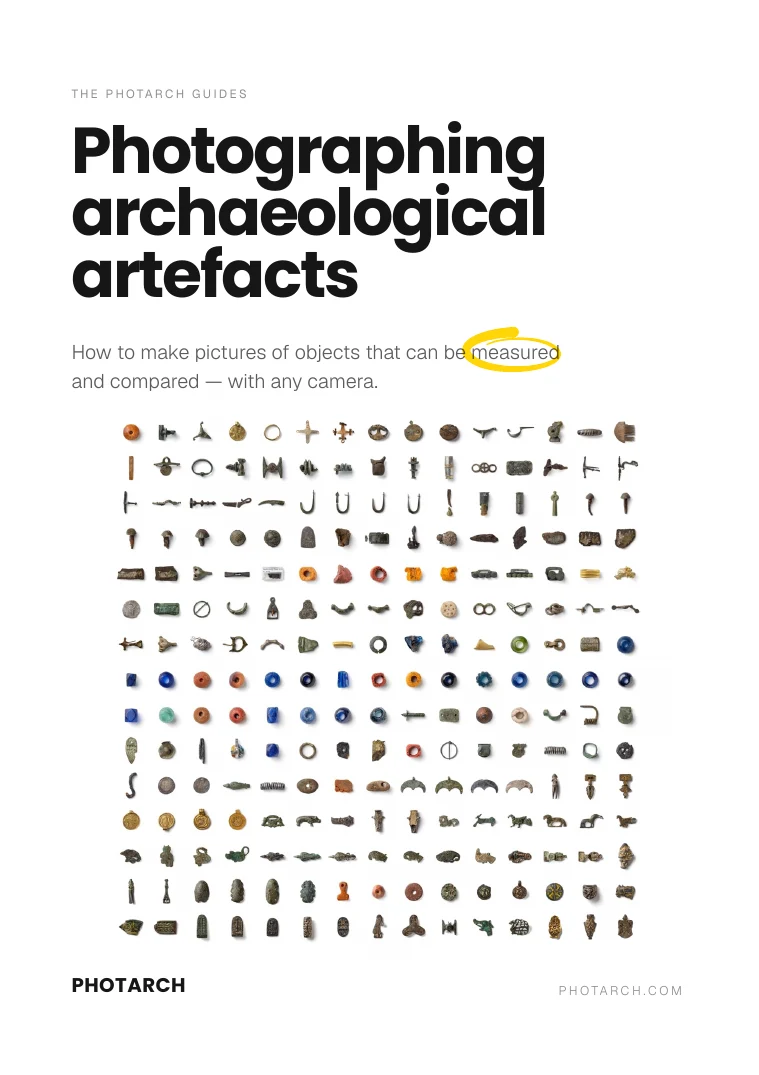
Photographing archaeological artefacts: the ten guides as one book — the light, the white ground, colour, the camera and the lens, scale and file formats — for the first picture and the ten-thousandth. For members, and membership is free: become a member, and you will have it when it is out.

Become a member
The cover of Photographing archaeological artefacts, the PHOTARCH guides

In development

What comes next

PHOTARCH on iPad

The app on iPad.

iPhone Duo

Optimized for iPhone Duo.

Board

The PHOTARCH board, to photograph objects on.

Guidebook

All the guides as one book.

The principles are public — the archive is open

To learn the method and to use what is already in the archive are free of charge. The software is for the organisations that want to document their objects that way themselves.

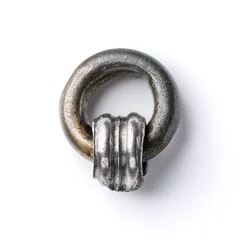
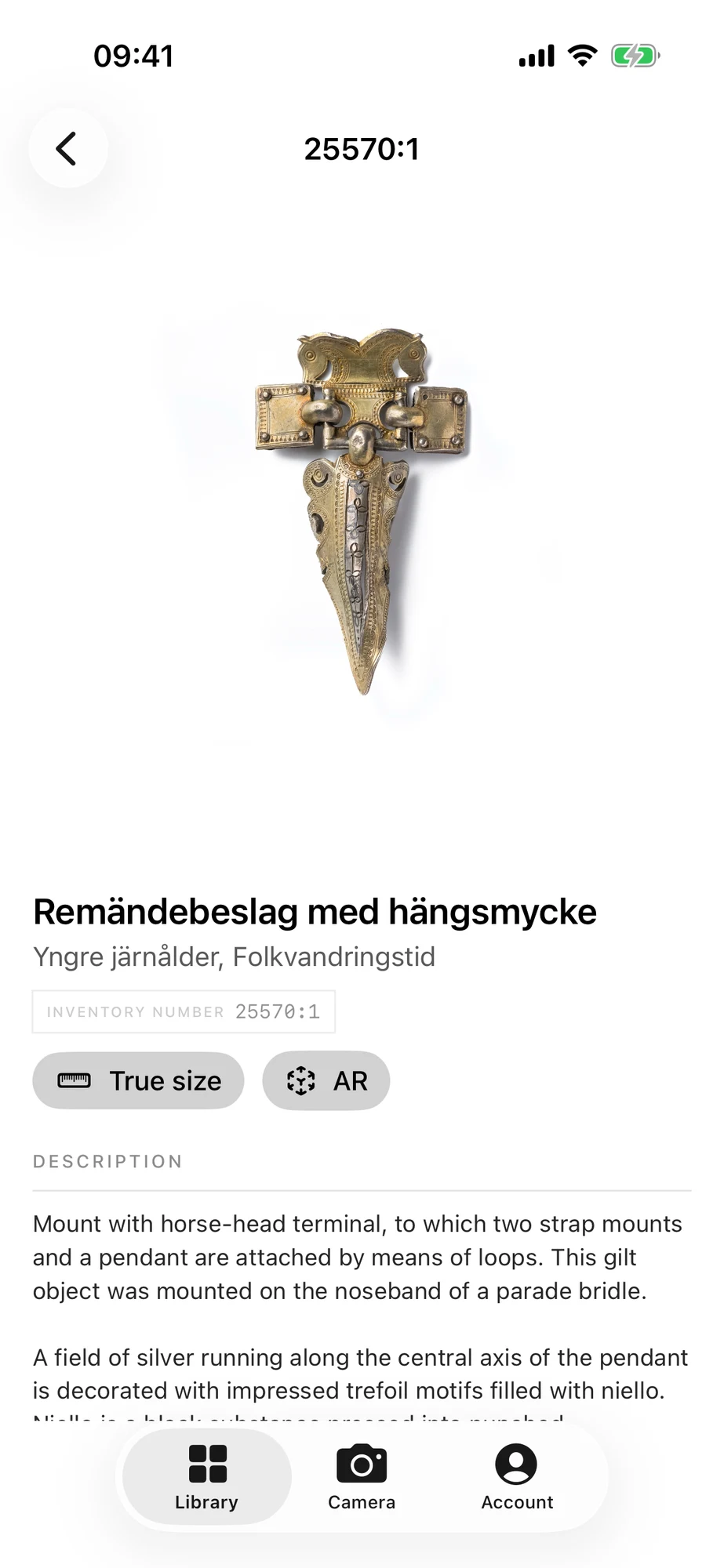
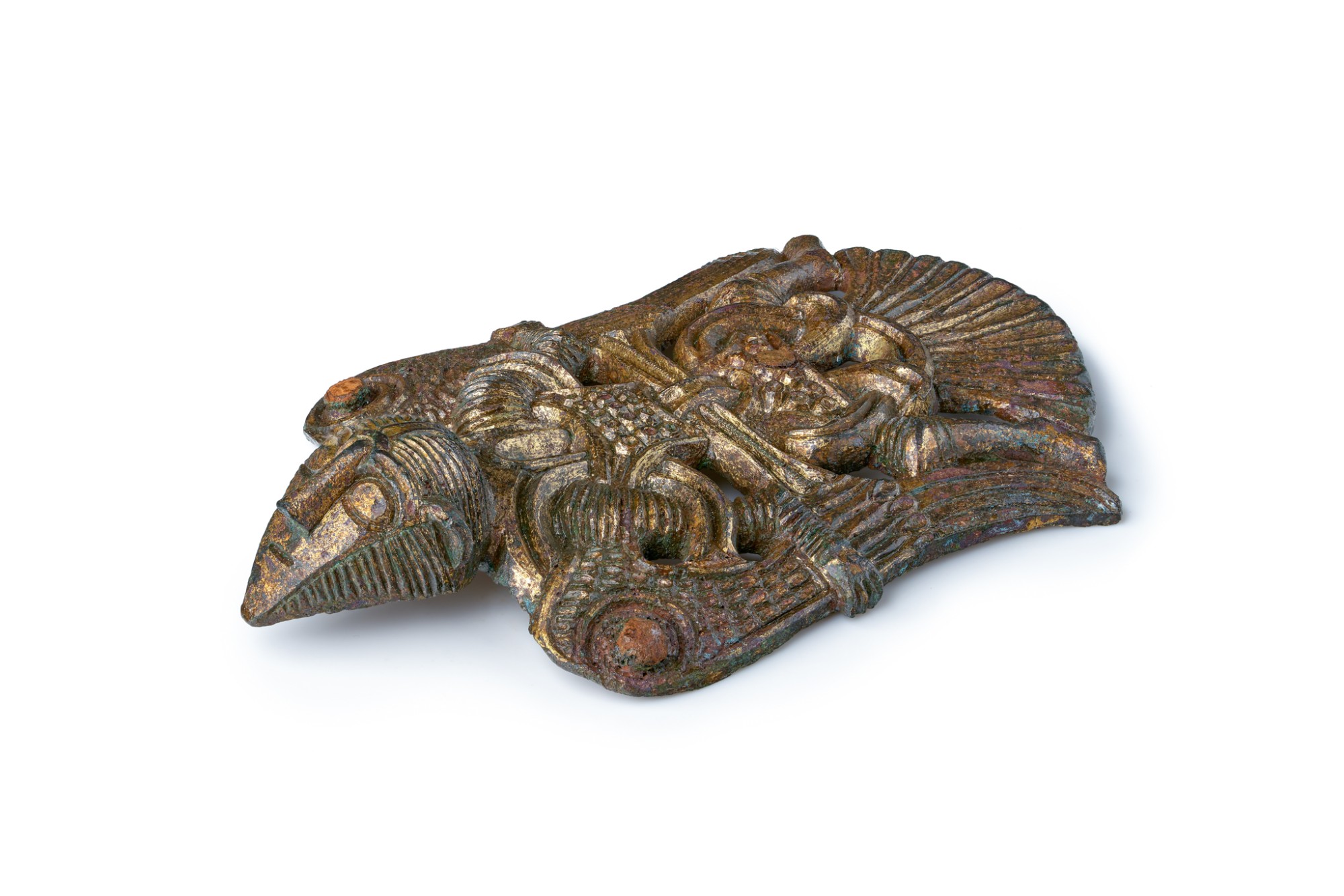
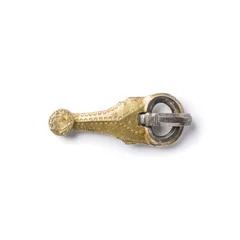
A gilded mount on white, photographed at an angle